As divisions grow, role of Yemen’s Hadi in doubt


 0
0


DUBAI: Yemen’s president holds court with top diplomats, dispatches letters of condolence or congratulations, and presides over periodic meetings with aides. He sometimes grants television interviews.
But after three years of gilded exile in Riyadh, whose military coalition has yet to roll back his Houthi rebel rivals, President Abedrabbo Mansour Hadi is increasingly seen as a marginal figure — and even by some as an obstacle to peace.
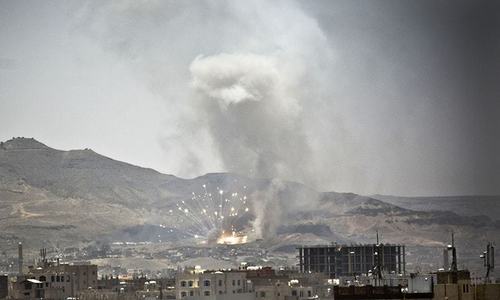
The Saudi-led alliance was launched in March 2015 with the goal of pushing back the Iran-allied Houthis, who seized control of much of the country including the capital Sanaa, and restoring the internationally recognised government to power.
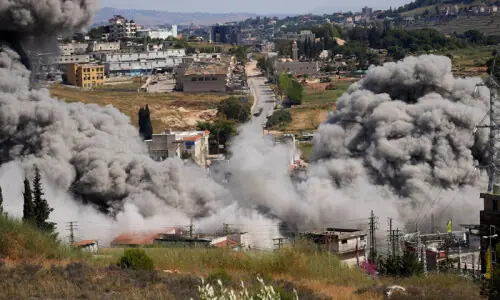
The conflict has left nearly 10,000 people dead and tens of thousands wounded, creating what the United Nations says is the worst humanitarian crisis in the world.
Now entering its fourth year, the coalition has shown signs of internal division, with some questioning the utility of Hadi to their cause.
Embodiment of government
Hadi is the embodiment of Yemen’s internationally recognised government.
He was appointed president in 2012 as part of a political deal that saw his predecessor Ali Abdullah Saleh cede power after months of street protests.
When the Shia Houthis overran Sanaa in late 2014, Hadi was forced to flee the capital, going first to the southern city of Aden — then into exile in Riyadh.
While the United Nations has since recognised Hadi as Yemen’s president, that has not fazed the Houthis or even coalition member the United Arab Emirates, which in recent months torpedoed Hadi’s authority in the southern port city of Aden.
In January, southern separatists backed by Abu Dhabi attacked pro-Hadi forces in Aden, overrunning the city. The government was forced to hunker down until Saudi and Emirati envoys arrived, in a visit publicised in UAE state media, to quell the infighting.
That showdown was the manifestation of the UAE’s exasperation with Hadi, viewed as incompetent and too close to the Muslim Brotherhood, analysts say.
The Emirates and Britain, which backs the coalition both diplomatically and with arms, are in favour of a shuffle in the government camp, according to regional sources close to the process.
While aware of their Yemeni ally’s shortcomings, the Saudis have made restoration of the government their mission. The United States, which provide weapons, intelligence and aerial refuelling to the Saudi-led coalition, also sees Hadi as key to an eventual accord.
“At the end of the day Hadi, for all of his failings, represents something very important if we want to reach a political solution in Yemen,” a senior US official said on condition of anonymity.
“The way the Emiratis are acting in the south is complicating the task of reaching a political solution. It’s only perpetuating the problem of Yemen which is the militias, and armed groups,” said the official.
The tensions with the southern separatists, and ever-present threats from Al Qaeda and the militant Islamic State group jihadists, mean Hadi’s ministers cannot govern from the city they once declared their temporary capital.
Plan B
A spokesman for the Hadi government, Rajeh Badi, told AFP that “the majority of ministers are spending the bulk of their time in Aden”.
But most of those ministers are from Yemen’s formerly independent south.
Ministers who hail from northern Yemen work mainly from Riyadh.
They include Foreign Minister Abdel Malek al-Mikhlafi, who makes periodic visits to the government stronghold of Marib in central Yemen, as well as Vice President Ali Mohsen al-Ahmar who has difficult relations with the separatists.
Hadi has not stepped foot in Yemen for about a year, while two of his ministers quit in March accusing Saudi Arabia of controlling his movements.
In a September 2017 interview with Saudi-owned Al-Arabiya TV on the sidelines of the UN General Assembly, Hadi said a military solution was “the most likely” to force an end to conflict.
But Yemeni political circles are increasingly looking for a way out — floating a Plan B — aimed at fostering a political process in the war-torn country.
Hadi would keep his “ceremonial” role as the head of state, but in effect be replaced by a political figure from the north — an executive vice-president capable of negotiating an accord with the northern Houthi rebels.
“Hadi will inevitably remain a key figure in the process solely by virtue of his position as Yemen’s internationally recognised president and head of Yemen’s internationally recognised government,” said Adam Baron, a fellow at the European Council on Foreign Relations.
Published in Dawn, April 12th, 2018