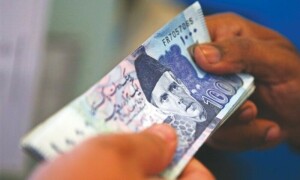
To retain the element of surprise the State Bank of Pakistan (SBP) in its monetary policy statement on March 30, 2018 has decided to maintain the policy rate at 6.0 per cent for the next two months.
Many analysts, however, were anticipating a hike of 25 to 50 basis points in the policy rate. Depreciation leads to an increase in the real interest rate, consequently the policy rate goes up as a counter measure to stabilise macroeconomics.
Without going into the nitty-gritty of the Consumer Price Index (CPI) calculation and inflation expectations the monetary policy has termed the core inflation as “sticky” while the core inflation has been increasing for the last eight months due to buoyant crude oil prices.
The core inflation is 5.8pc in March — the highest level recorded in the past three years. Apparently the SBP wants to keep the momentum of the gross domestic product going in the remaining months of fiscal year 2018 till the elections.
Private Sector Credit (PSC) is very vital; a congenial low-interest rate environment has helped in sustaining and propagating the PSC. With increase in interest rates, private debt repayments increase, money becomes expensive; a cooling and stabilisation process kicks in.
Total foreign exchange reserves have touched record lows of $17.948 billion; anchoring foreign exchange market sentiment and curbing the current account deficit while maintaining the easy monetary policy stance would be impossible.
Policymakers face a macroeconomic trilemma of three typically desirable but contradictory objectives of stabilising the exchange rate and engaging in a monetary policy oriented towards domestic goals, along with free capital mobilisation.
In Pakistan’s context, dwindling foreign currency reserves have the significant and limiting impact of choosing one of the three desirables. Low real interest rate and a managed floating exchange rate can cause capital outflow due to arbitrage opportunity between the loan market and foreign exchange market.
Moreover, low interest rates encourage firms to book their imports, forcing financial intermediaries to buy foreign currency and sell domestic currency in order to maintain the fixed exchange rate in the face of the appreciation pressure.
The currency market has started feeling the heat as the dollar closed between Rs116.60 and Rs116.80 in the open market on Tuesday.
Policymakers are aware of the fact that official inflows and foreign direct investment (FDI) will be insufficient to finance the current account deficit. The government is planning to narrow the current account gap by mobilising external inflows.
The government intends to use both official and commercial inflows to bolster reserves. Recently, the International Monetary Fund’s (IMF) executive board examined the mounting threat of debt crises to macroeconomic development and stability in low-income developing countries.
The IMF cautioned that two issues can amplify risks from elevated debt levels in low-income countries; the first is a marked change in the composition of debt, pushing up servicing costs and making debt expensive to serve.
Secondly, the fund has noticed that borrowers have moved away from traditional official creditors to sovereign bond issues and other foreign commercial lenders mainly to commercial banks.
PCS on a commercial basis often comes at shorter maturities and higher interest rates, yielding larger debt service burdens for the borrower countries and higher rollover risks when these debts mature.
The total external debt has increased from $83,092 million to $88,891m, a rise of $5,799m during July 2017 to December 2017.
Reportedly, the World Bank and the Asian Development Bank have already withheld balance of payments policy loans of $700m to Pakistan due to deterioration in macroeconomic indicators this year. The perceived repayment risk can negatively impact the capital flow.
Monetary policy does not create growth; it orchestrates a sustainable economic development. To choose a favourable trade off the policymakers should also show a positive political stewardship by taking hard monetary decisions and attaining the fiscal discipline.
Published in Dawn, The Business and Finance Weekly, April 9th, 2018