Air strikes resume in Ghouta as Russian truce plan falters


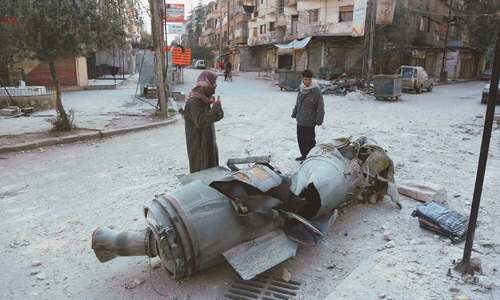
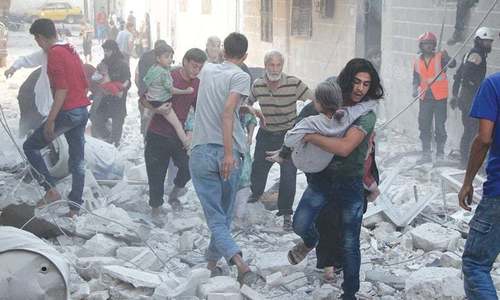
BEIRUT: A Russian call for a five-hour truce on Tuesday failed to halt one of the most devastating campaigns of the Syrian war, where residents said government warplanes resumed striking the eastern Ghouta region on Tuesday after a brief lull.
Moscow and Damascus blamed rebels for the collapse of the truce, saying fighters had shelled a safe route intended for civilians to leave the enclave. The insurgents denied such shelling.
Russian Foreign Minister Sergei Lavrov said Moscow would press on with a plan to stage similar daily pauses in the fighting, allowing aid to be delivered to eastern Ghouta through what Russia describes as a humanitarian corridor.
The United Nations said it was proving impossible to aid civilians or evacuate the wounded, and said all sides must instead abide by a full 30-day ceasefire demanded by the UN Security Council.
“We have reports this morning there is continuous fighting in eastern Ghouta,” UN humanitarian spokesman Jens Laerke said. “Clearly the situation on the ground is not such that convoys can go in or medical evacuations can go out.”
Hundreds of people have died during 10 days of government bombardment of the eastern Ghouta, an area of towns and farms on the outskirts of Damascus. The assault has been among the most devastating air campaigns of a war now entering its eighth year.
With its Ghouta offensive, the Syrian government of President Bashar al-Assad is drawing on the military methods it has used to crush its opponents in other parts of Syria, including eastern Aleppo in late 2016.
Intensifying bombardment of the besieged area has been coupled with probing ground assaults to test rebel defences.
With no sign of decisive international pressure to stop the attack, eastern Ghouta seems likely to meet the same fate as other areas won back by the government, where humanitarian corridors eventually became escape routes for defeated rebels.
“A concrete humanitarian corridor has been set up that will be used to deliver humanitarian aid, and, in the other direction, a medical evacuation can take place and all civilians who want to leave can,” Lavrov told a joint news conference in Moscow after meeting French Foreign Minister Jean-Yves Le Drian.
Escalation
Residents in several towns in the eastern Ghouta described a brief pause in fighting, but said bombardment swiftly resumed. In the town of Hammouriyeh a man who identified himself by his first name Mahmoud said helicopters and warplanes were in the sky and conducting strikes.
The Britain-based Syrian Observatory for Human Rights monitoring group said helicopters and warplanes had struck four towns and artillery shelling killed one person.
A UN Security Council resolution passed on Saturday called for a 30-day ceasefire across the entire country, but did not specify when it should start. It excludes some militant groups which are among the rebels in eastern Ghouta.
That has meant the ceasefire has not been observed in practice. UN spokesman Laerke declined to comment on the Russian proposal for a five-hour truce, but called instead on all sides to obey the full 30-day ceasefire.
Published in Dawn, February 28th, 2018