SOME years ago, CIA contractor Raymond Davis was on trial for murder. While the proceedings went on, the US consul-general explained the laws of qisas: an eye for an eye.
“I gulped,” remembered Davis, “because I assumed this would be my fate.”
But with qisas came the escape hatch: the laws of diyat. “The victims’ families are going to receive a sum of money,” said the consul-general, “then you’ll be getting released.”
There’s a troubling change of heart in the Shahzeb Khan case.
Davis didn’t like the plan, but the consul-general assured him, “It’s the best deal you’re going to get.”
It’s what we tend to miss about qisas and diyat: while it’s a major way justice is frustrated in this country, it’s also one among several to those with means and influence.
Davis had enablers far beyond the penal code: from Husain Haqqani stamping his visa to Gen Pasha “continually texting [the US ambassador] about the court proceedings”.
Even exceptions like prosecutor Asad Manzoor Butt, who fought the case with everything he had, were replaced by the state. Thus the system prevailed, and Davis walked free.
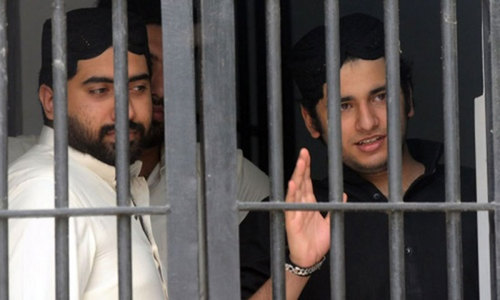
In Shahzeb Khan’s case, we come to the same cruel conclusion. Five years ago last week, Shahzeb was shot four times in Khayaban-i-Bahria, Karachi. Per witnesses, Shahrukh Jatoi was told his victim was still alive. Jatoi shot him again.
That Shahzeb was the son of a police officer meant nothing when pitted against the spawn of two feudal franchises. It was only when Iftikhar Chaudhry and the Supreme Court got into the act, and thunder rained down from Mount Olympus, that there was movement. The FIR was beefed up with anti-terror provisions. Real arrests were made. For a gent that deserves all the flak he gets, Chaudhry was the reason Jatoi ended up in a death cell at all.
But even though diyat was thankfully no longer applicable (by the grace of said anti-terror provisions), the Raymond rules came into play again: game the system hard enough, and you walk away with murder. Especially when the system, i.e., the Sindh government, is your partner.
First, Jatoi was rushed to Dubai via Bilawal House protocol officers. Then came the Sindh government lobbying the presidency for a pardon. Then came air conditioners and gaming consoles for Jatoi’s prison cell. Then came the defence counsel: Farooq H. Naek, former chairman Senate, former law minister, and lead firefighter for Asif Zardari.
Finally we come to the saddest twist in the tale: last month, the Sindh High Court threw out the terror provisions in the case and ordered a retrial, thus enabling blood money. The family pardoned Jatoi, because it had been broken already. Shahzeb’s aunt says his father was “continuously beaten” and “[taken] to the hospital bleeding”.
Wondrously, it was the very same Sindh High Court that had ruled the opposite earlier: that Jatoi created a “sense of helplessness” in the public, and anti-terror provisions were “fully attracted”.
Indeed, the anti-terrorism court ruled it was terror in March 2013. The Sindh High Court ruled it was terror in May. And the Supreme Court ruled it was terror in October.
But now the Sindh High Court has had a change of heart, in a six-page decision that never discusses its own previous ruling. And even though the Supreme Court has also already deemed it terror, the high court relies on another, wholly distinguishable Supreme Court decision called ‘Waris Ali’. Yet even there, the Supreme Court upheld life imprisonment, unlike the Sindh High Court, which throws out Jatoi & Co.’s convictions altogether.
Some progressives are hailing this flip-flop, because the jurisprudential definition of ‘terrorism’ seems a far greater cause than ensuring feudal thugs don’t spray innocent kids with bullets. So we cede to the most insipid, limousine liberalism, where words like ‘procedure’ and ‘parameters’ are sung with notes so high, Shahzeb’s family never reaches them. On the other end of the spectrum, some slam the father for yielding to his son’s murderers. They would do better to pray they never have to live a day in his shoes.
But what now? The state won’t file an appeal because it’s in on it. The family won’t file an appeal because it’s made to be in on it. Instead we look to miracles: that the Supreme Court take suo motu notice; that it accept a petition moved by Karachi’s finest citizens to revisit the high court decision; or that the trial court deem the crime fasad-fil-arz, preventing pardon.
Until then, we can only look at the abuse of the qisas/diyat laws, the soullessness of the Sindh government, and the compulsions of a justice system that has to apply terror provisions to block pardons, and scream reform.
Because until we fix them forever, the Raymond rules will continue apace. “It didn’t seem possible,” Davis wrote of his release. For the briefest moment, it didn’t seem possible for Shahrukh Jatoi either.
The writer is a lawyer.
Published in Dawn, December 28th, 2017