0
0

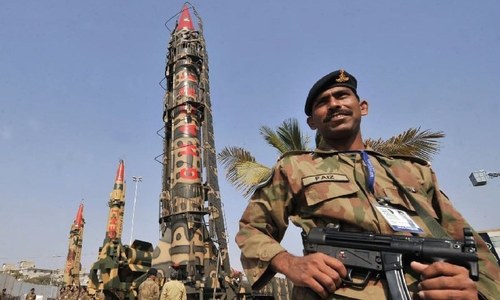
ISLAMABAD: The start of negotiations to ban nuclear weapons at the United Nations could have unseen implications for Pakistan particularly with regard to its position on Fissile Material Cut-Off Treaty (FMCT).
“The Foreign Office needs to be cautious about it; a new trend is being set up. The UN is negotiating the nuclear ban treaty. FMCT can be taken to the UN as well,” an official said at a roundtable organised by the Centre for International Strategic Studies (CISS) titled “Nuclear ban treaty: debating the missing Link”. The roundtable was held to discuss the start of talks at the UN on proposed treaty for outlawing nuclear weapons.
The first round of talks was held from March 27 to 31 at the UN as a result of a resolution adopted last December calling for negotiating a legally binding treaty. Pakistan was among the 40-odd countries including other nuclear weapon states that boycotted the talks. The second round of negotiations is slated for June/July, when the draft text of the treaty would be considered.
The official expressed fears that this “dangerous precedent” could lead to FMCT being negotiated out of Conference on Disarmament (CD), which he said was the appropriate forum for such deliberations. He recalled that there were “already lots of voices” complaining about the deadlock at the CD on FMCT.
Boycotting negotiations could put Pakistan at a permanent disadvantage and compromise its security interests
Pakistan has been applying a hold on the start of negotiations on the grounds that FMCT, which only bans future production of fissile material without taking into account the existing stockpiles, would freeze the existing asymmetries, thus putting Pakistan at a permanent disadvantage and compromising its interests.
He further worried that some other countries, at the same time, might try to extract political mileage by deceiving others with their interest to join the treaty.
The official said the proposed ban could also undermine Nuclear Non-Proliferation Treaty (NPT), causing it to unravel.
Other speakers expressed apprehensions that the goal of global disarmament, even though a noble cause, may be an impractical pursuit.
Executive Director of CISS Amb Sarwar Naqvi said the concept of nuclear ban looked fanciful, though a manifestation of human desire of creating an ideal world.
Dr Christine Leah, visiting research fellow with CISS and Postdoctoral Fellow and Lecturer at Yale University, said she wasn’t convinced that the general idea of global nuclear disarmament was a good one.
She said nuclear weapons were here to stay and called for a rethink of arms control concepts developed during the Cold War period to adjust to multi-polar Asian maritime context. In her view, the move towards global disarmament could cause deterrence to rely on conventional force imbalances.
Dr Zafar Khan, who teaches at the National Defence University, Islamabad, opined that the “prospects for universal arms control and nuclear ban were dim”. He said for complete disarmament to happen the international community would have to address issues of discrimination, negative security assurances, conventional imbalances, conventional and nuclear force modernisation, need for restructuring of non-proliferation regimes, and conflict resolution.
President of the Strategic Vision Institute Dr Zafar Iqbal Cheema cautioned against complete nuclear disarmament in the absence of a conventional arms control regime, saying that doing so could push the world into an era of destruction and chaos. “Idea of disarmament looks noble, but under what circumstances do we intend to achieve it,” he wondered.
Published in Dawn, April 16th, 2017