New Pak-Afghan border controls slow trade to a crawl


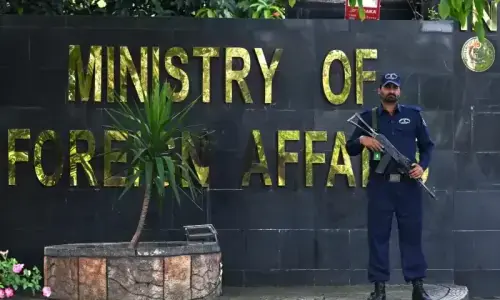
For decades Afghan and Pakistani merchants crossed freely at Chaman, a dusty, wind-swept frontier town in Pakistan's southwest, but an unprecedented bid by Islamabad to impose border controls is sparking fears for bilateral trade.
Chaman is one of just two major crossings from Afghanistan into Pakistan, where until recently border controls were virtually absent along the disputed colonial-era line crossed with impunity by traders and travellers.
But a new attempt by Pakistan to secure the once porous frontier is wreaking havoc, with thousands of people and hundreds of trucks forced to queue at Chaman's “Friendship Gate” until their movements are processed on an electronic system that went online in September.
Traders used to crossing at will now find themselves waiting for hours while some say their trucks can at times sit idle for weeks at a time, meaning perishable goods go to waste.
Businessmen like Fazal Karam complain of delays and customs duties eating into their already narrow margins.
“My truck has been left standing on the border for 15-16 days”, the 50-year-old Afghan fodder trader said.
Officials on the Pakistani side have even dug a trench which runs parallel to the border, blocking anyone who might try to circumvent the official checkpoints.
Islamabad ─ which has also tightened controls at the other major crossing, the famed Torkham Gate on the Khyber Pass ─ insists the new measures are necessary to stop the flow of militants and boost customs revenue.
The Pakistani government estimates that undocumented trade on the border exceeds $2.5 billion annually, costing millions of dollars a month in lost customs duties.
Landlocked Afghanistan imports basic goods like milk, juices and household items while exporting fruits; Pakistanis buy cheap electronics, fabrics, medicines and tyres brought over by Afghan traders.
One door in Afghanistan, one in Pakistan
The two nations are divided by the “Durand Line”, a 2,400-kilometre frontier drawn by the British in 1896 and disputed by Kabul, which does not officially recognise it as an international border.
Ethnic Pashtuns living along the border have traditionally paid it little heed, with villages straddling the frontier that have mosques and houses with one door in Pakistan and another in Afghanistan.
Pakistanis cross it daily to work, regional analyst Rahimullah Yousafzai said, while Afghans cross it to visit family and receive medical treatment, or, as in Torkham, send their children to Pakistani schools, all of which is affected by Islamabad's added controls.
“It should be acknowledged that there is a human angle to this,” Yousafzai told AFP.
Islamabad's announcement last June that it was planning more checkposts and fencing along the border prompted consternation from Afghan officials.
Abdullah Achakzai, president of Chaman's chamber of commerce, said the majority of people in the area depended on cross-border trade for their livelihoods.
“Local people who have their shops across the border in Afghanistan, who go in the morning and come back in the evening, are facing serious problems,” Achakzai said.
“They waste three or four hours just to cross, how can you do business for half a day?”
Driving trade underground
With no alternatives ─ such as long-term visas ─ available yet, businessmen have resorted to smuggling. “Sometimes they conceal goods in hay stacks, and from time to time they try to bring across vehicles disassembled into various parts,” said one official.
Achakzai conceded controls were necessary but must be imposed more fairly.
“In the wake of these difficulties, they must lower tax rates by 20 to 30 percent,” he said.
Abdul Hadi, a shopkeeper, warned the controls may have unintended consequences.
“If unemployment increases, people will turn to theft and robbery,” he said. “It's in the government's best interests to resolve this. “