37
37

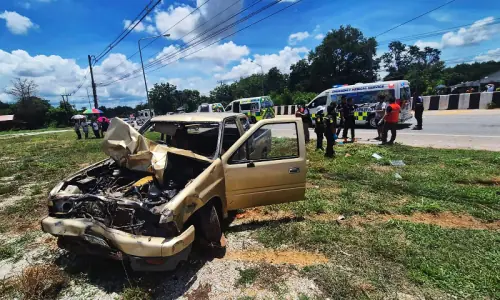
I drive down the Lahore-Multan Road as part of my daily commute everyday. Yesterday on my way back home from the office, a signboard showing a blood-soaked body of a road accident victim jumped out at me.
The sight was so grisly that I had to halt my car; my stomach churned as my mind registered the graphic image.
The provocative signboard put up by National Highway Authority and Motorway Police, who operate and administer the N-5 route, read:
"Caution: Wear Helmet...Save Life"
followed by:
"Watch your left and right before getting on the highway"

After regaining composure, I realised that the signboard was installed for public awareness.
To its credit, it may encourage bike riders to wear helmets. But my beef is with the explicitly graphic image of a road accident victim — how does it constitute public viewing?
Take a look: Why Pakistan needs a 400 per cent increase in traffic challans
Many will contend that graphic images have long been placed on cigarette packages to discourage people from smoking. However, there is one significant point we cannot discount while comparing the two: the audience is very different.
The signboard in question is out in the open for everyone, including naive, impressionable minors, to see.
Is it appropriate to burden them with gory images of traffic accident victims?
On the other hand, cigarettes packets are likely only purchased by those who smoke them.
Perturbed I went home that day with a question bothering me immensely: How could NHA and MP — two organisations for which I have immense respect — put up something utterly lacking in sensitivity and sensibility?
See: Pakistan's traffic accidents record: Punjab down, KP up since 2011
I was positive that they had merely emulated the image already put up somewhere else. I carried out a rigorous Internet search in a quest to find similar signboards. Hours of browsing only revealed a letter containing proposals regarding public interest signs addressed to the India Youth Secured Organisation.
It also included a sample of a signboard showing an image of an accident victim. Upon further research I found out that the idea was not implemented by the Indian police. This meant that the NHA signboard was the first of its kind.
Effects of gore
Research conducted by American Academy of Pediatrics (AAP) and American Academy of Child and Adolescent Psychiatry (AACAP) shows that exposure to violent media (which includes the display of blood and gore) can lead to real-life violent behavior, while also harming children in other ways.
Moreover, gory and bloodied images can also contribute to sleeping problems due to nightmares.
Now imagine a school-going child, who uses the Lahore-Multan Road to commute, viewing this deeply troubling signboard every day.
What does the law say?
According to 8(2) and 8(3) of Pakistan Electronic Media Regulatory Authority's (Pemra) guidelines for media:
"Appropriate warning shall be given upfront for content which may be potentially disturbing or upsetting so as to enable a viewer to make an informed choice."
followed by:
"Scenes with violence or suffering such as close-up shots of persons brutally tortured or killed shall not be shown."
With such a code of conduct imposed on the media, it is apparent that the state realises that it is not okay to post graphic content that is intended to be shocking. And yet, these gory signboards are state-sponsored.
Yes, it is supremely important to have public awareness campaigns in a country where there is a blatant violation of traffic rules, and thousands lose their lives in road accidents annually but we should not be terrorised into good traffic awareness at the cost of our mental health.