6
6


LONDON: Nigel Farage has devoted his career to campaigning to leave the European Union, a once-impossible seeming goal he has now achieved following a referendum campaign peppered with his signature controversies.
It was the rise of Farage’s UK Independence Party (Ukip) which effectively forced Prime Minister David Cameron to first promise a referendum in 2013.
Farage has played a high-profile role this year in the push to leave the EU. However, true to form, he frequently drew criticism with stunts such as a poster showing a queue of migrants to argue Britain should take back control of its borders.
Addressing ecstatic supporters in London early Friday, Farage said: “I now dare to dream that the dawn is coming up on an independent Britain.
“We’ve got our country back,” he declared as the result became clear.
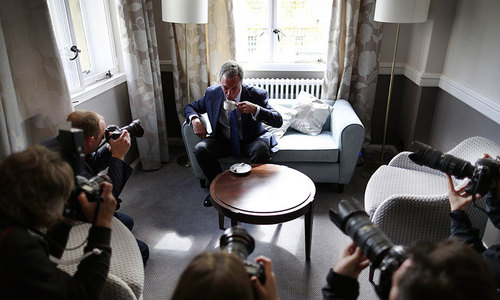
The charismatic 52-year-old, who is often photographed with a pint of beer, embarked on a nationwide tour on a battle bus well stocked with alcohol and blasting out the theme to the film The Great Escape, with almost daily speeches.
His straight-talking, man-on-the-street style resonates with many older, white, blue collar voters and is reminiscent of a bygone era when the economy felt stronger, immigration was lower and Britain was great.
But Farage can be a polarising figure and was kept away from the official Leave campaign — spearheaded by former London mayor Boris Johnson — for fear that he could alienate voters.
His unveiling of an anti-migrant poster reading “Breaking Point” last week just hours before pro-EU British lawmaker Jo Cox was killed was condemned even by fellow Leave campaigners.
Michael Gove, the anti-EU Justice Secretary, said he “shuddered” when he saw it.
‘Fruitcakes, loonies and closet racists’
Farage has almost single-handedly made Ukip a major force in British politics, even though it only has one MP in the House of Commons and was once dismissed by Cameron as a party of “fruitcakes, loonies and closet racists”.
It was the rise of Ukip, draining away support from Cameron’s Conservatives, which prompted Cameron to pledge a referendum on EU membership in 2013 if the Conservatives formed a majority government at the next election.
Many at Westminster believe the premier never thought he would have to honour that pledge as he was governing in a coalition government at the time and his party looked unpopular.
But the Tories swept to a surprise victory in last year’s general election, forcing Cameron to call the vote.
Farage was born in 1964 to an affluent family in Kent, southeast England.
His father was a stockbroker and an alcoholic and his parents divorced when he was five.
He was educated at one of England’s top private schools, Dulwich College in London, where he says his headmaster saw him as “bloody-minded and difficult”.
Rather than attending university, he followed his father into the City of London, where the former commodities trader says boozy lunches were the norm.
Having supported the Conservatives since his school days, he joined Ukip in 1993 as a founder member and was elected to the European Parliament in 1999, aged 35.
Farage became Ukip’s leader in 2006 before standing down in 2009 and then being re-elected the following year, when Ukip’s ascent really began.
He has repeatedly failed to be elected to the Commons himself but has survived a string of personal misfortunes — a serious car accident and testicular cancer as well as a plane crash.
Farage has four children — two boys by his first wife and two girls with his German second wife Kirsten.—AFP
Published in Dawn, June 25th, 2016