101
101

ISLAMABAD: Pakistan has expressed its concern over growing strategic ties between India and the United States (US), a day after the two countries signed a number of agreements for security cooperation during Indian Prime Minister Narendra Modi's visit to the US.
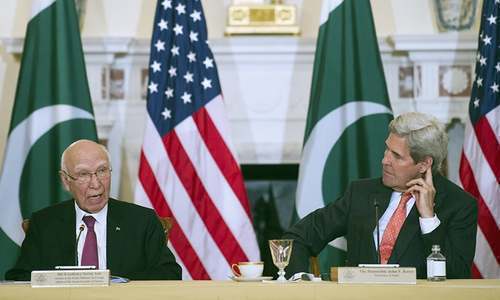
Addressing a press conference at the Foreign Office (FO) on Thursday, the Adviser to the Prime Minister on Foreign Affairs Sartaj Aziz said that the US approaches Pakistan whenever it needs it, and abandons it when it doesn't need Pakistan.
"Pakistan will convey its concerns to US over the latest issues in the bilateral ties," Aziz said, adding that a high-level meeting is planned between Pakistan and US officials on June 10 in Islamabad.
"We firmly conveyed it to the US that maintaining effective nuclear deterrence is critical for Pakistan's security and only Pakistan itself can determine how it should respond to growing strategic imbalance in South Asia," he said.
Know more: Indian inclusion could affect strategic stability, Pakistan tells Nuclear Suppliers Group
The adviser said Pakistan has decided to take up the issue of Kulbhushan Jadhav, an Indian spy who was recovered from Balochistan, with the United Nations and other international forums.
He said the statement made by Director General of India's National Investigation Agency (NIA) that no evidence linked Pakistan to the Pathankot attack has vindicated Pakistan's position in attack probe.
This statement comes as Indian PM Modi wrapped up a visit to Washington as one of President Barack Obama's closest international partners.
The developing Indo-US relationship is seen as a foreign policy success for the Obama administration.
Washington views India as an important part of its re-balance to Asia and as a counterweight to China.
The two countries are finalising various agreements that would make it possible for their militaries to cooperate more closely in the future. Under one such agreement, an American company will build six nuclear reactors in India.
The perpetually oscillating Pak-US relationship is once again at low as reflected by the Congressional restriction on financing of F-16 fighters’ sale from Foreign Military Financing programme, because of which Pakistan lost the opportunity to buy the jets.
The relationship was further strained when the US carried out a drone strike in Balochistan, killing Afghan Taliban leader Mullah Akhtar Mansour, which was termed by Pakistani leadership a violation of the country's sovereignty.