4
4
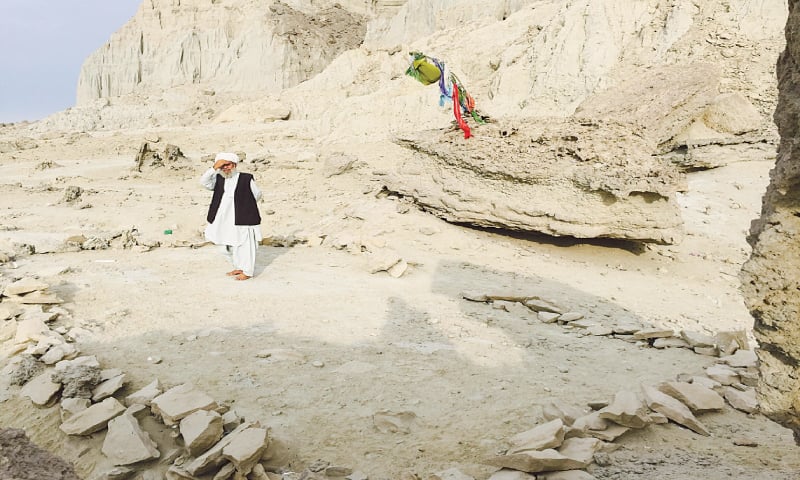

ON a dry and dusty morning, the silhouette of a boat-shaped mountain is visible once one enters the main road leading from the airport towards Gwadar city. The mountain is called Koh-i-Mahdi (Mahdi’s Mountain), my colleague informs me, and people belonging to the Zikri faith visit the site for a pilgrimage every few weeks. A narrow, rocky route leads to the top, which is usually covered by the young who make the half-hour journey on their family’s behalf and offer a goat for sacrifice after the mandatory prayers.
Making a turn from the main road brings us to Jahli Dor, a residential area right beneath the mountain and a kilometre away from the sea. There is a juxtaposition of the old and the new in Jahli Dor where 165 families currently reside, most of them a mix of Zikri and Namazi. Some of the homes are solidly built with concrete whereas others are made of mud. The area will be categorised as a Free Trade Zone in May under the Gwadar Port Authority project and as an initial compensation for relocation, the families residing there received between Rs300,000 and Rs400,000. There are roads around Jahli Dor and another similar settlement adjacent to the mountain known as Mullah Bundh.
The eastern side of Koh-i-Mahdi is called Jambeel and the western side is called Batail in Balochi. Zikris hailing from these areas are often known as Bataili or Jambeeli Zikris, a 78-year-old resident of Jahli Dor, and our unofficial guide from the area, Maanzna Pindi, says.
“Whatever I know about my faith is through the narrations of our elders and maulana who believed that the Imam came to Gwadar first from Arabistan (the Arabian peninsula of south-west Asia) and spent seven days on top of the mountain in Gwadar, which is how it got its name,” he explains. “Koh-i-Mahdi and is now a place of pilgrimage and religious importance for the Zikris living here.”
The fishermen of Gwadar refer to themselves as Mahdizi, says Pindi, as they believe they have an ancestral link with the place as well, “but it is often contested and argued between the Zikris and them”.
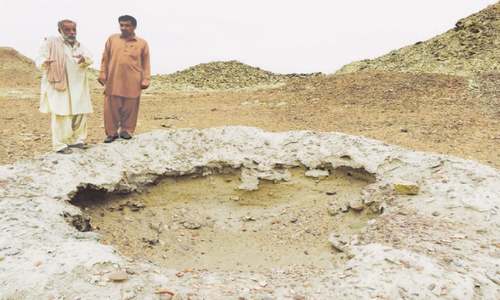
There are currently two places for zikr, one on the top of the mountain and the other situated a kilometre away from Jahli Dor. The story goes that an old resident of the area, Mahikan, who led a group of pilgrims at the top of the mountain every Friday till she was about 70 years old and stopped only due to worsening health, saw a dream before passing away and informed the elders of the area. “She dreamed that people who are not able to climb the mountain should make their offerings near the sea,” says Pindi. Though the woman passed away in 2007, residents built a praying area by putting rocks in a square which is visited by anyone who can’t make the difficult climb up.
For the past two years, there has been an influx of Zikris from Awaran, Turbat, Mund and Kharan to Gwadar, due to persecution and reports of harassment at the hands of Namazis. Scholars and anthropologists say the persecution of Zikris has its roots in the 18th century. It is not known exactly how many Zikris live in Gwadar or in the southern belt of Balochistan, as there is no official figure on the number of Sunni and Shia Muslims in Pakistan, says assistant professor at Habib University in Karachi, Dr Hafeez Jamali. Speaking about the Zikris, he says, “It is a little known Islamic sect with a heterodox belief system which has faced political persecution at the hands of various regimes or religious groups over the centuries.”
Belonging to the Mahdawi sect founded in the 15th century by Syed Mohammad Jaunpuri, Zikris are integrated well in the Makran region. In a chapter on the Zikris of Balochistan in the Islam and Society in Pakistan: Anthropological Perspectives, Inayatullah Baloch writes: “The Zikri doctrine states the mission of the Prophet Muhammad (peace be upon him) was to preach doctrines of Islam but it remained on the Mahdi to further elucidate its meaning.” He further writes that the “Mahdawi message had its greatest and most enduring impact upon the people of southern Balochistan where Zikrism was for centuries associated with the area’s ruling dynasties”.
Moreover, scholars contend that the beliefs Zikris associated themselves with was not an issue, as from the rulers in Kalat down to the ordinary citizens of the Makran region, people wedded within the Zikri community — until the rise of Sunni ruler Mir Nasir Khan and his 1749 invasion of Makran.
Back in Jahli Dor, Pindi recently received part of the compensation to move from his current abode. What about the site of pilgrimage, my colleague asks. “We carry the ziarat within us, it goes wherever we go,” he responds calmly.
Published in Dawn, March 13th, 2016