KARACHI: The country incurs revenue losses of billions of rupees every year due to the ‘illegal fishing activities’ of Indians, who deliberately violate Pakistan sea limits, said commander Ghazi Salahuddin of the Pakistan Maritime Security Agency during a workshop held at local hotel on Wednesday.
Part of a USAID-funded project being implemented by the World Wide Fund for Nature-Pakistan, the workshop was the last of a series of such events conducted in different cities to seek recommendations from relevant stakeholders to develop a national level strategy to combat wildlife crimes in the country.
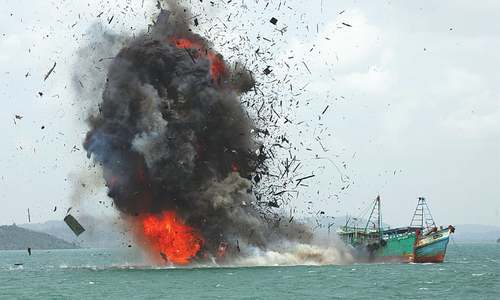
Giving a presentation on the efforts in place to control illegal, unreported and unregulated fishing (IUU)/wildlife trafficking, commander Salahuddin said illegal fishing activities of Indian vessels was a key threat to fisheries resources.
He said the Indian boats equipped with global positioning system (GPS) deliberately violated Pakistan sea limits to poach fish available in the Indus delta.
“They are not inadvertent crossers as widely believed here. Most Indian boats are fitted with the GPS, which shows that fishermen are well aware of their locations. Second, they are often caught fishing 100 nautical miles inside our waters,” he said.
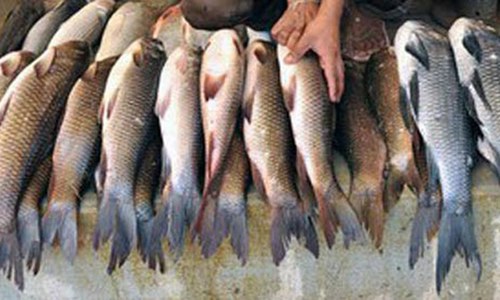
Citing a PMSA study, he said around 600 Indian vessels entered Pakistani waters for fishing illegally every month while the revenue loss of four-month of illegal Indian fishing had been estimated to be around Rs8bn.
Replying to a question, he said the number of Pakistani fishermen caught on the other side of the border was small as compared to the Indian fishermen caught here.
Other crimes, he said, could be carried out through illegal fishing. Recently, he said, the PSMA had confiscated an Iranian boat with illegal oil and fine quality drugs.
“We should have some national plans to take up the matter of illegal fishing with regional countries. All boats operating from our coastline should be properly registered,” he said.
Replying to a question regarding checking of banned fishing nets, he cited a case in which the organisation had to face a lot of political pressure when it stopped two boats. “If we start checking every boat, no boat will be operated from here.”
Syed Ali Raza, independent lawyer and member of the wildlife commission of Punjab, briefed the audience about the legal perspective on animal rights. Unlike the Bangladesh, Indian and Afghanistan constitutions, he noted, there was no mention of wildlife in Pakistani constitution.
All the inherited laws regarding wildlife, he said, were not specifically framed with the objective to conserve wildlife, but rather enacted with relevance to human life.
Recent cases relating to the hunting of houbara bustard and the ‘political use’ of an animal, he said, had highlighted the gaps in laws relating to wildlife.
Technical adviser with WWF-P Mohammad Moazzam Khan shed light on various aspects of IUU fishing issues in Balochistan and called for effective implementation of the Convention on International Trade in Endangered Species of Wild Fauna and Flora (CITES) and the Indian Ocean Tuna Commission (IOTC) regulation of which Pakistan was a signatory.
He appreciated the fact that the workshop included representation of all major stakeholders that had a critical role in the battle against illegal wildlife trade and was an important milestone to eliminate wildlife crime from the country.
The event, he said, would help strengthen knowledge and skills of law-enforcement agencies and develop partnerships to effectively curb wildlife crimes.
The recommendations put forward by experts representing Sindh and Balochistan wildlife departments, the ministry of climate change, Pakistan customs, the judicial academy and the marine fisheries department, included updating the relevant legislation.
It was pointed out that the Sindh wildlife protection ordinance did not provide protection to the marine cetaceans and the law needed to be amended to include these species.
Participants also suggested that the draft regulations to implement the Pakistan Trade Control of Wild Fauna and Flora Act 2012 at the provincial level should be finalised and implemented on immediate basis.
There were also recommendations for setting up rehab facilities for confiscated animals and wildlife information desks at the exit and entry points, which had been recognised as illegal trade hotspots.
Published in Dawn, February 25th, 2016