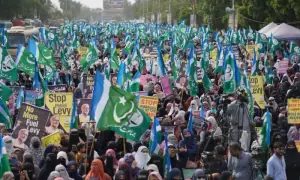
HUNDREDS of angry protesters took to the streets of Luari Sharif on the outskirts Badin last week. They ransacked shops, and then set them ablaze. They attacked homes, and torched them too. The mob was motivated by the killing of a local teacher in the broader context of a long-standing dispute between groups over ownership of local shrines.
A few weeks ago a mob went on the rampage in Jhelum, burning down an Ahmadi-owned factory. Announcements made from the loudspeakers of local mosques rallied the mob by accusing the factory’s owners and employees of committing blasphemy. A night later, a separate mob attacked a nearby Ahmadi place of worship. This mob needed no goading. It was likely provoked by the police cordon around the site — the state’s audacity at seeking to protect the most vulnerable. When the police tear-gassed the mob, it responded by pelting policemen with stones.
A little over a year ago, a mob in Kot Radha attacked a Christian couple, accused them of committing blasphemy, broke their legs, and then threw them into the brick kiln at which they worked. They were killed by the fires they had stoked.
There is no shortage of horrifying tales of mob justice.
There is no shortage of horrifying tales of mob justice in Pakistan, nor want for gruesome details. The practice — and our resignation to its ubiquity — seems to be woven in the fabric of Pakistani society.
But mob violence should not be easily overlooked. The persistence of mobs seeking violent justice is the clearest indication we have of the failings of our legal system. States are defined by the fact that they have a monopoly over violence — where that is not the case, the state is necessarily weak. In places like Pakistan, where mobs murder, plunder and commit arson with impunity, it is clear that the combination of poor law enforcement and structural injustice is literally deadly.
Writing in the Atlantic on mob justice in Nigeria, the author Teju Cole said “mobs arise out of … crisis. They are a form of impatience”. The crisis Cole refers to is
the transition in societies from feudal and tribal to democratic forms of justice. Pakistan is in the midst of this crisis: while the backlog at our under-resourced and overly corrupt courts grows, many Pakistanis continue to turn to waderas, sardars, mullahs, militant commanders, and pirs to settle disputes, uphold ‘honour’ and mete out swift justice.
Mobs in Pakistan also offer a false sense of safety. When you’re part of the mob, you’re strong. Join the mob, and you ‘win’. The notion that it is necessary to be part of the dominant group — no matter how horrifying its practices — is gaining rapid traction in Pakistan as democratic ideals such as pluralism and inclusivity are sidelined in favour of top-down state control and extremist positions, both of which allow only single visions to endure, and so demand a ‘winner’ in all scenarios.
The prevalence of mob violence in Pakistan also allows us to make distinctions between ‘us’ and ‘them’— the urban and the rural, the privileged and the poor, the cultured and the wild. This allows us to express horror — much as I’m doing here — but also feel safe in the knowledge that people like ‘us’ are not in the proximity of people like ‘them’ who carry out mob justice.
But that is not how it works. The mob can get you — subsume you, or attack you — at any time. Indeed, by accepting the lifting of the moratorium on the death penalty and implicitly condoning the extrajudicial tactic of countering militancy through police ‘encounters’, many of us could already be considered part of the mob.
The worst thing about mobs is that it’s difficult to confront them. The collective action implies that the mob has the moral high ground, and those opposing the mob are wrong.
But mobs in Pakistan often have more to do with money than morality. They are often cynically orchestrated by ‘dera daars’ as a form of political and economic manipulation. Mobs for hire come cheap in Pakistan, but the fact that they can be easily rallied points to the same judicial failings and social inequalities that lead to spontaneous mob violence elsewhere.
The time is well past for Pakistan to seriously tackle mob justice. The judicial and economic reforms needed to address underlying triggers of mob violence will take time. But police capacity to take action against mobs and prevent participants from acting with impunity can be improved now with training and resourcing.
We can also no longer continue to circumvent the failings of the criminal justice system (for example, by introducing military courts). The perceptions of injustice that the lack of due process creates will in the long run lead to more violence. And that would mean the mob has won.
The writer is a freelance journalist.
Published in Dawn, December 21st, 2015