ISLAMABAD: A gathering of media practitioners and legal experts was told on Thursday that there was no law in Pakistan that guaranteed the safety of journalists, and that the state – rather than protecting journalists – actually creates an enabling environment where media personnel can be targeted for doing their jobs.
An official from the Ministry of Law, Justice and Human Rights also raised many eyebrows on Thursday when he said that journalists were “among the most vulnerable groups in society”.
Speaking during a discussion on impunity for those who perpetrated violence against journalists, the law ministry’s Khashishur Rehman said, “If something happens to them, it impacts the society as a whole.”
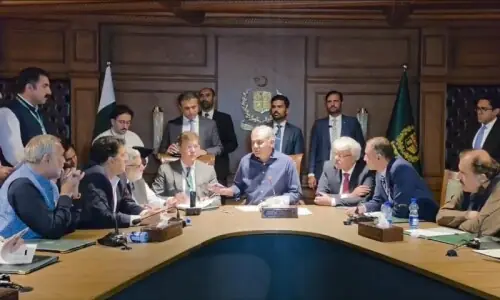
These claims were made at ‘Supporting Safety of Journalists in Pakistan’, a consultation held to assess the journalist safety indicators developed by Unesco. The event was attended by journalists, media practitioners, academics, legal experts and UN representatives.
The indicators are meant to pinpoint matters that impact the safety of journalists and map the features that help assess the extent to which journalists are able to carry out their work safely.
Wali Babar’s brother makes impassioned appeal to end impunity against the press
Mr Rehman also admitted that the issue of impunity stems from “the erosion of the criminal justice system”.
He also said Pakistan was one of the most over-legislated countries in the world.
Discussing the legal aspects of the impunity with which journalists can be silenced, lawyer and columnist Saroop Ijaz pointed out that actions such as banning YouTube and outlawing online criticism of the government created an environment that encouraged extremist views regarding the media and freedom of expression.
“When the state tells people to ‘shut up’, it sets a precedent that it is OK to force someone into silence,” he said, referring to the murder of Saleem Shahzad. He said that only national security states ‘measured’ how patriotic a journalist was.
He said that all protections and legal cover for journalists would be for naught if they were not allowed to cover what they wanted to. “Journalists aren’t responsible to any notion of national security, but the truth. Everything else is a corollary.”
He concluded by saying that journalist safety could not be divorced from the state of free expression in any country, adding that in Pakistan, both were under threat.
Talking about protection mechanisms for local journalists, Guy Berger – Unesco’s Director for Freedom of Expression and Media Development – said, “You can’t import or export journalist safety; there are no UN peacekeepers in blue helmets who will come and protect you. Local actors must take the lead in this regard.”
Wali Babar
Most of the speakers highlighted that in Pakistan, only two cases of journalists who were murdered had reached any conclusion so far: the murders of Daniel Pearl and Wali Khan Babar.
The most moving talk of the day came from Murtaza Babar, brother of the slain Geo TV reporter, who made an impassioned plea for journalists to look after their own. “For God’s sake, take notice. Enough journalists have died. Hanging the culprits won’t bring my brother back, but it will benefit journalists working in dangerous environments,” he said.
Speaking about the hardships that he and Wali Babar’s family had to endure after his murder, Murtaza Babar said that “three courts, four judges and eight public prosecutors later”, his brother’s murderers still eluded justice.
“At least seven people – including informants, police officers and their relatives – were killed because they were connected to Wali Babar’s case,” Murtaza recounted. “No lawyer was prepared to take up our case, and one who did was also killed.” He claimed that no one from Wali Babar’s organisation or the various journalist bodies had inquired after the family while all these killings were taking place.
“There have been three attempts on my life, but I’ve not gone public with this information, for fear of scaring off the few people who are helping us,” he said.
Murtaza also suggested that journalist bodies help strengthen the investigative capacity of law enforcement agencies, since that was the weakest link in the system.
Published in Dawn, October 30th, 2015
On a mobile phone? Get the Dawn Mobile App: Apple Store | Google Play