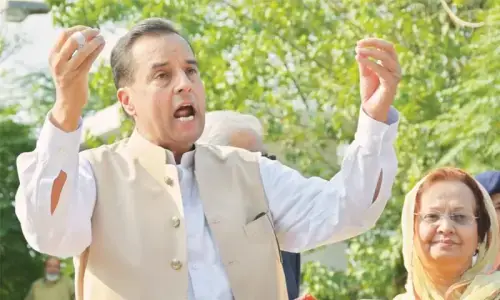
LAHORE: Former chief justice Tassaduq Hussain Jillani has called for dissemination of constitutional literacy among people for social change in society.
He was speaking at a two-day conference on “Role of Judiciary in Enforcing Human Rights in South Asia” organized by South Asia Partnership (SAP) and Pakistan Institute of Labor Education and Research (PILER) at a local hotel on Saturday. Delegations from India and Pakistan participated in the conference while jurists, legal experts, intellectuals and civil society representatives also graced the occasion.
Chairing a session on Rights of Religious Minorities, Justice Jillani emphasized on Supreme Court judgments on religious freedom and minority rights. He lauded the efforts and tolerance of bold judgments and said the society that had such jurists would be a just and balance society.
He said there were four articles in the Constitution which addressed the minorities’ rights, social justice and ensured human security of all citizens.
He said the Supreme Court was the catalyst for social change, a democratic and liberal institution and had trickle down effects on other institutions. He said the state must ensure minorities rights and guarantee their security.
Retired Justice H Suresh from India said Indian courts had given their verdicts on secularism, but there was a dilemma that words of socialism and secularism were being abolished from the preamble of Indian Constitution.
He condemned hate speeches and material terming them a cause of Muslim population’s massacre and hatred for untouchables in Indian population that they were not allowed to go for worships in the temples.
Special Assistant to Prime Minister Barrister Zafarullah highlighted the need to establish a national commission on child rights, which could address the issue of forced child marriages in Pakistani society.
He referred to forced conversion of Hindu minor girls in Sindh province especially. He revealed that Parliament was working on the legislation on Hindu Marriage Act and Right to Information Act was being reviewed to make the law more useful.
HRCP Secretary-General I.A Rehman referred to various verdicts of courts regarding abduction of Hindu girls, their forced conversion and forced marriages. He expressed concern over unhelpful role of courts towards religious minorities.
Mr Rehman regretted that there were at least eight treaties signed by governments, on minority rights, but they were not acceptable by the governments.
An Indian delegate, Gayti Singh, spoke on labour law in India and said contract workers in India were not being regularized and many textile workers lost their jobs due to the shutdown of many mills.
Published in Dawn, April 12th, 2015
On a mobile phone? Get the Dawn Mobile App: Apple Store | Google Play