LATELY, Pervez Musharraf has been unburdening himself of some of his views on democracy. In a BBC interview, he said that while he believed in democracy, he did not consider the Western version of the system appropriate for Pakistan. And speaking at a youth forum in Karachi, he said that his coup-making predecessors had all acted in the national interest.
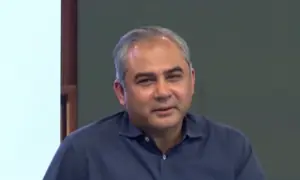
Elaborating on these themes in a conversation at his Karachi home, he told me that to strengthen democracy, there must be an institutional provision for the military to be represented in political decision-making at the highest level. This, he maintained, would prevent future coups, and would help forge a consensus between the civilian and military leadership.
I am old enough to recall General Ayub Khan’s mantra: “Parliamentary democracy does not suit the genius of the people of Pakistan.” This has been the recurring theme running through all our military governments as generals have sought to justify and legitimise their interventions.
The method they have chosen has been to discredit politicians as well as the culture of corruption and incompetence they have helped to create. Few thinking Pakistanis would dispute that our politicians have been on a collective suicide mission for decades, and periodically trigger military coups by their greed and inability to provide decent governance.
Ambitious generals have seized on these opportunities, usually to acclaim from a public tired of squabbling, venal politicians who seem to get nothing done apart from lining their own pockets. Each time, the generals have started by promising to clean up the system, but ended up becoming much like the politicians they despise, compromising and making deals in a bid to perpetuate their rule.
Musharraf thinks all military rulers acted in the national interest.
Despite our long and bitter experience of military rule, there are many Pakistanis who profess to support democracy, but who nevertheless argue for military intervention when they are unhappy with the current elected civilian leader. When Zardari was in power, I heard many arguing that Gen Kayani was shirking his duty by not removing an allegedly corrupt government. And now, as Imran Khan’s protests splutter along, voices in the media and in drawing rooms across the country wonder aloud why Gen Raheel Sharif has not sacked the PML-N government.
And this is the point: democracy in Pakistan is still struggling to put down deep roots because we are too impatient for change, and too intolerant of views that are different from ours. So after a year or two, we tire of elected governments. Dictators, by contrast, play far longer innings, thanks to their armed and uniformed constituency.
Gen Musharraf thinks all military rulers have acted in the national interest. Without questioning their patriotism, I fear each of them has left the country worse off when they have been pushed out. Not necessarily in strict economic terms, but in terms of the damage inflicted on national institutions. Instead of evolving naturally and improving over time, our political system has been subjected to sharp and frequent shocks that have destabilised democracy time and again.
And by pursuing narrow military interests, our generals have taken us far from our natural path. Militant groups created and fostered to push our army’s agenda in Kashmir and Afghanistan now threaten the state. Apart from souring relations with our neighbours, their violent, hate-filled ideology has made Pakistan a pariah state.
As a fighting force, the military does not see the value of soft power in an increasingly globalised world where economic might and cultural achievements are major factors in determining a country’s place in the pecking order. But as Pakistan slips further behind India, the fundamental flaw in our military’s thinking is exposed.
Above all, generals wielding political power tend to surround themselves with fellow officers from much the same background. They uphold the institutional interest of the military, and are equally insulated from the rough and tumble of civilian life. So decision-making usually lacks a diversity of inputs. Also, disagreement with a superior officer is discouraged in the military.
This is probably why Musharraf held his disastrous referendum. And while his attempt to instal a system of local government across the country was intended to bypass established political parties, it was still a worthy effort to empower people at the grass-root level. However, in the process, destroying an established administrative structure did far more harm than good.
But to be fair, virtually unfettered political power does give the incumbent the authority to carry out reforms an elected government would lack the will to implement. In Musharraf’s case, he did away with a discriminatory system of separate electorates, and increased the number of reserved seats for women in parliament. Had he used his sweeping powers to regulate the madressahs and rein in religious intolerance as he had promised, we would have had much to thank him for. As it is, we are left with a number of what-ifs?
Published in Dawn December 13th , 2014