0
0
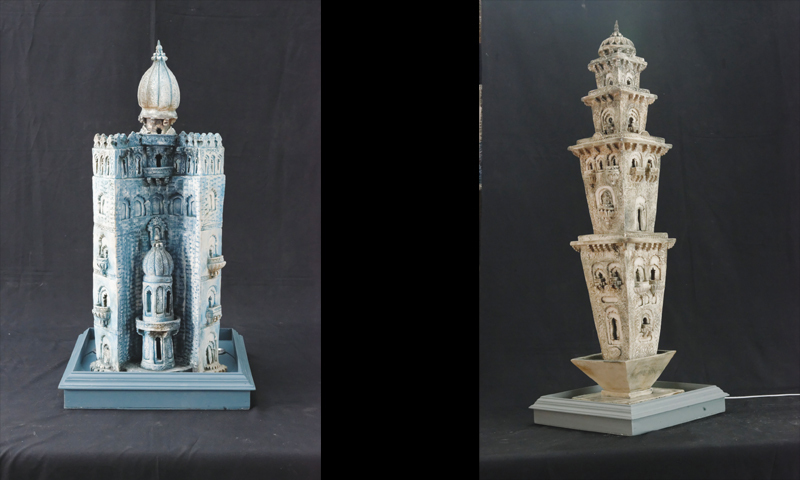
Ceramic art is a centuries old practice in the subcontinent, especially in the Indus Valley civilisation. The figurines, seals and pottery found in Mohenjodaro and particularly Harappa show that the pivotal medium of expression was clay or terracotta.
Jamil Hussain is a ceramist who possesses an urge to share his utmost feelings and observations with others. This characteristic has made him a socially aware artist who owns his past, lives in the present and longs for a prosperous future. He has four solo-exhibitions to his credit; all based on a specific emotional, individual and conscious understanding of his surroundings and atmosphere. Hussain has taken up the tender and soft nature of clay to personify his heart-felt sentiments towards the vanishing architectural heritage of his beloved hometown.
The artist fell in love with this medium when he created a mould of his mother’s hands and later, to pay homage to her, crafted them in ceramic with all his emotional attachment. He tried to personify whatever he could relate to those hands that caressed, pampered, cared, soothed and protected him through thick and thin. His connotation of those hands carried a fear — they would vanish one day! Later, he implied the same fear for the diminishing architectural heritage of Lahore.
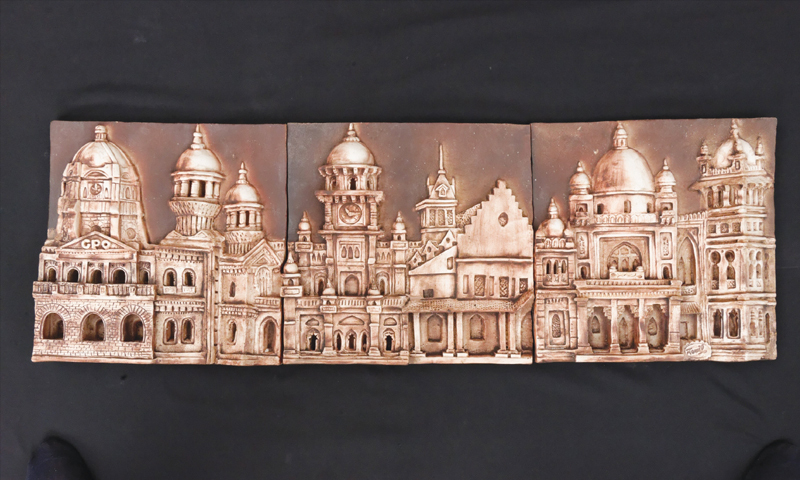
In the recent exhibition ‘The Past Lives On’ at the Collectors Galleria Lahore; Hussain has given vent to his nostalgic concerns. Through the ceramic idiom, he has displayed the buildings and architectural patterns of the Mall Road; a romance of the bygone days, when he used to tread aimlessly around the colonial period’s red-brick buildings of the Lahore Museum, the Tollington Market, the GPO, the High Court and the Punjab University Old Campus.
Other than colonial period buildings, the artist seems to be obsessed with the traditional architecture of the Walled City, studded with the enchanting jharokas and balconies. Apart from the nostalgic value, the artist again focuses on the rapidly vanishing architectural heritage of Lahore and other cities. Many of his pieces present a half-broken or deteriorating state of this glorious heritage, which needs attention.
On the artistic side, the ceramist has not tried to reproduce the key models of the architectural heritage but has unleashed his imagination to capture the conceptual and thematic value in his art. The individual and emotional affiliation of the artist with this heritage has caused an artistic distortion in many of his pieces. The elongated shapes, intricate decorative patterns and the traditional elements of canopies or domes formulate an expression that can compel a viewer to touch and feel these pieces. “I just want to enter this door and walk through the corridors of these small buildings,” a visitor expressed her feelings irresistibly.
Along with the free-standing ceramic sculptures, Hussain also exhibited many high-reliefs on the walls which attracted many serious buyers. However, these reliefs were framed like a painting suggesting a feeling of unnecessary confinement.
Hussain has very successfully experimented with the centuries-old technique of ceramic, which has never been considered for sculpturesque expression in Pakistan. His devotion and involvement in this painstaking technique, has enabled him to create niches in the brittle solidity of baked clay where he can put his memories alongside his dreams.