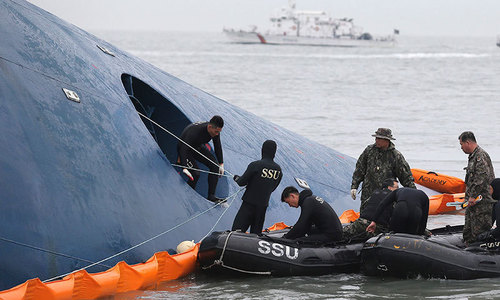
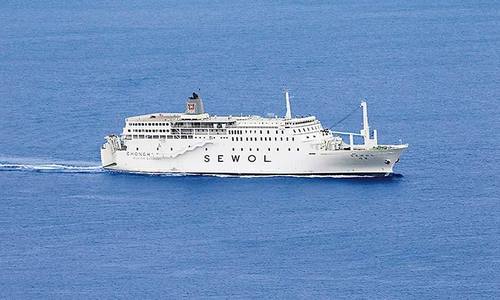
JINDO: Divers began retrieving bodies Sunday from inside the submerged South Korean ferry that capsized four days ago with hundreds of children on board, as families angered by the pace of the rescue efforts scuffled with police.
Coastguard officials said 16 bodies had been removed from the ship which sank on Wednesday morning, pushing operations further along the painful transition from rescue to recovery and identification.
The retrieval of the first bodies from the interior came after prosecutors revealed that the officer at the helm of the 6,825-tonne Sewol when it capsized was not familiar with those particular waters.
The confirmed death toll from the disaster stood at 56 with 246 people still unaccounted for.
Three bodies were pulled out of the fully submerged ferry just before midnight and another 13 were recovered later Sunday morning, a coastguard spokesman said.
The breakthrough followed days of fruitless efforts by more than 500 divers to access the capsized ship, while battling powerful currents and near-zero visibility.
It was a watershed moment for distraught relatives who have clung desperately to the idea that some passengers may have survived in air pockets in the upturned vessel.
The bodies were placed in tents at the harbour on Jindo island – not far from the disaster site – where the relatives have been camped out in a gymnasium since the ferry went down.
In a process that looks set to be repeated with tragic frequency in the coming days, they were checked for IDs and other particulars, after which their relatives were informed and asked to make an official identification.
Trauma of identification
Some of the policemen standing guard at the tents were openly weeping, while the cries of the family members could be heard from inside.
Of the 476 people on board the Sewol, 350 were high school students headed for the holiday island of Jeju.
The devastated relatives have repeatedly denounced what they feel has been a botched, delayed and incompetent emergency response to the disaster.
Nearly 200 family members set off Sunday on a hike from Jindo to Seoul – 420 kilometres to the north – where they planned to march on the presidential Blue House in protest.
Scuffles broke out when they were prevented from crossing the bridge to the mainland by a large police detachment, and eventually they were forced to turn back.
One of the marchers, Chung Hye-Sook, a mother of one of the missing students, said she was appalled that the authorities had begun taking DNA samples to facilitate identification of the bodies before the entire ferry had been searched.
“What are those people thinking?” Chung shouted.
“We are asking them to save our children's lives. We can't even think about DNA testing. I want to save my child first,” she said.
Three giant floating cranes have been at the disaster site off the southern coast of South Korea for days, but the coastguard has promised it will not begin lifting the ferry until it is clear there is nobody left alive.
Investigators have arrested the ferry's captain, Lee Joon-Seok who has been bitterly criticised for abandoning hundreds of passengers still trapped in the ferry as he made his own escape.
Also detained were a 55-year-old helmsman and the ship's young and relatively inexperienced third officer, identified by her surname Park, who was in charge of the bridge when the disaster occurred.
Tracking data shows the ship took a radical right turn while navigating through a group of islets off the southern coast.
Such a sharp turn could have dislodged the heavy cargo manifest – including more than 150 vehicles – and destabilised the vessel, causing it to list heavily and then capsize.
Inexperience at the helm?
While Park, 26, had been sailing the Incheon-Jeju for six months, “it was the first time for her to navigate this particular route,” a senior prosecutor told reporters Saturday.
The captain said he was returning to the bridge from his cabin when the ship ran into trouble. Questioned as to why passengers had been ordered not to move for more than 40 minutes after the ship first foundered, the captain insisted he had acted in their best interests.
“The currents were very strong...I thought that passengers would be swept far away and fall into trouble if they evacuated thoughtlessly,” Lee said.
The ferry tragedy looks set to become one of South Korea's worst peacetime disasters.
A Seoul department store collapsed in 1995, killing more than 500 people, while nearly 300 people died when a ferry capsized off the west coast in 1993.
Around 30 per cent of South Koreans are practising Christians and special prayers were said across the country on Easter Sunday for the ferry victims.