0
0

CBMs in Kashmir
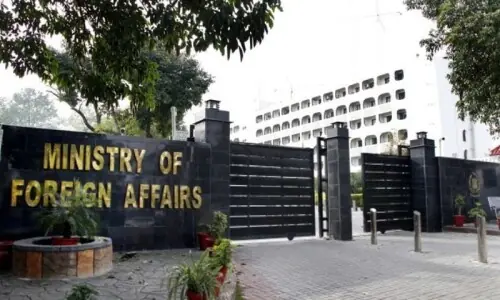
POSITIVE news on Kashmir and India must always be welcomed. Tomorrow the foreign secretaries of India and Pakistan will kick off the fifth round of the composite dialogue. Although progress in the first four rounds has been slow, it is good that the two countries remain committed to the process. On Friday, the Working Group on Cross-LoC Confidence-Building Measures announced the commencement of trade and increase in people-to-people contacts between the divided parts of Kashmir. The commerce minister, Ahmad Mukhtar, has meanwhile announced an increase in the number of items that can be legally traded with India. What is to be made of these steps? In the context of the long-running composite dialogue, they are not new ideas and are simply an incremental extension of past measures. However, in the context of recent events that have strained relations between India and Pakistan, they come as a reinforcement of the process of rapprochement.
The devastating bombing of the Indian embassy in Kabul and the subsequent allegations that Pakistan’s security apparatus orchestrated the suicide attack have strained relations between the two countries. The Indian national security adviser, M.K. Narayanan, made a remarkably direct allegation of the ISI’s involvement in the Kabul blast and called for the agency’s destruction. The Pakistan government has responded with remarkable equanimity to the allegations that could have sparked a bitter diplomatic row. The government has also remained mute as a controversy over the transfer of forest land in Indian-administered Kashmir to a Hindu shrine trust engulfed the area in protests and led to the fall of the government there.
The signs from Islamabad then are for better ties with India. Indeed, one of the few things that the fractious coalition in Islamabad agrees on is to push for a measurable improvement in our relations with India. How to get there remains another issue. Hawks in the Pakistani establishment remain wedded to the idea of ‘Kashmir first’ — the demand that normalisation of ties with India be predicated on a resolution of the six-decade-old Kashmir issue. But that is harmful to both Pakistan and India, whose economies and people have many synergies. In that context, the agreement to expand ties between Kashmiris on both sides of the LoC is significant. By agreeing to simplify the procedure of issuing travel permits, increase the frequency of the Muzaffarabad-Srinagar bus service and launch a postal service between the two cities, India and Pakistan have indicated their perception that ‘soft borders’ could bring people together and improve the political climate in the region. This may not solve the Kashmir issue directly. It will certainly facilitate a settlement in the long run.
An unsung death
WHEN they were introduced in Sindh three years ago, no one expected the boards of governors to bring about a radical change in the functioning of state-run hospitals. The experiment had already been tried out in Punjab without any tangible results. With the urban-rural divide much more pronounced in Sindh and with ground realities that are Karachi-specific, the idea had an even smaller chance of success in the province, if at all. Now that the boards have been dissolved, no one is going to mourn their death. For the millions who are condemned to visit these health facilities every year, the boards gave them nothing to cheer about. Patients continued to visit the same filthy premises that they were familiar with, stand in the same never-ending queues, and pay for their medicines because more often than not the hospital pharmacies had no stocks. Doomed from their very inception, the boards of governors failed miserably to make an impact in any of the four institutions where they were created — two in Karachi and one each in Hyderabad and Sukkur.
It was not as if the concept suffered from some inbuilt flaw of vision or understanding. On both counts, it was practical to have an autonomous body managing the affairs of hospitals that were malfunctioning for a long time. The reason behind its utter failure and subsequent abandonment is the manner in which it was executed. Appointing bureaucrats to head the boards was hardly an inspiring decision. Saddled with hand-picked individuals from various fields with little or no understanding of the complex matter of healthcare management, the boards soon became part of the problem. Making matters worse was the fact that the autonomy that was promised to the BoGs never came their way. With neither the government nor the bureaucracy, nor indeed the members of the boards, sincere to the cause of improving healthcare services for the poor, the end was never in doubt. By removing the BoGs, the government has at least eliminated one tier of the administrative red tape that was delaying decision-making. It is a bit disturbing, however, that the provincial health minister is not quite clear about what he thinks is the best solution beyond the BoGs. It would have given everyone a reason to feel confident had he thought it out before doing away with the boards. For all said and done, it cannot be denied that some independent mechanism is needed to oversee the workings of the public-sector hospitals in the province.
Dengue in Islamabad
ONE would like to view the early detection of a couple of confirmed cases of dengue fever in Islamabad last week as a positive indication of the level of alertness of the capital’s healthcare system. In the past few years, outbreaks of dengue fever transmitted by the Aedes aegypti mosquito have usually taken place later in the year after the monsoon rains. Previous outbreaks in Islamabad may be nowhere near the proportion of the dengue epidemics in South-east Asia, which can affect tens of thousands of people, or even dengue outbreaks in Karachi which has seen far more serious outbreaks with many lives lost. Nevertheless, continued vigilance and surveillance of the disease plus a sustainable mosquito eradication campaign throughout the year, particularly during and after the monsoon period, are essential to keeping the culprit mosquito under check.
No sooner had the first dengue case been confirmed in Islamabad — the victim being a Frontier Constabulary jawan who had been posted in the capital city for the past month — hospitals in the twin cities were put on alert. The Islamabad city authorities started fumigation operations in public places and the federal health minister vowed to prevent the spread of the disease. But since the dengue virus transmission is often a problem of domestic environmental management as well, a lot more needs to be done in terms of public education. This involves getting the people to recognise the problem, assume a share of the responsibility for its solution, and acquire the capability and motivation to prevent and control dengue fever. A campaign to keep the twin cities mosquito-free, advertised over the media and in schools, can go a long way towards improving public involvement and education. Households should also be educated about the importance of controlling larval habitats in homes and surroundings, and combating adult mosquitoes by screening windows and doors and using household insecticides and sprays. A hotline for people to report potential and actual mosquito breeding sites could also be launched to help the city authorities in their eradication efforts. Last but not least, the city authorities need to keep a constant check on all construction sites and vacant properties which are well-known breeding grounds for mosquitoes.
OTHER VOICES – Bangladesh Press
Resignation that exposes deep trouble
Jugantor
THE resignation of Attorney General Fida M. Kamal points to trouble in the country’s justice system.
The top law officer’s post-resignation comments suggested deep dissatisfaction and pointed to apparent intervention in his work by government agencies. He said he had resigned for personal reasons. At the same time, Kamal said it was difficult for him to work under “these circumstances with integrity and dignity”.
His comments allude to an apparent rift between the government and the attorney general over some high-profile cases that involve former prime ministers Khaleda Zia and Sheikh Hasina and Jamaat-i-Islami chief Motiur Rahman Nizami.
The rift widened over a permanent attorney service. Many believe that his resignation was the outcome of this growing conflict with the government.
The post of attorney general carries special weight in every country. Any conflict will have a negative impact on the country’s justice system. Ministries or other agencies are not expected to mount pressure on the office of the attorney general.
It has been a long-running demand that the attorney services be overhauled for the sake of efficiency. The caretaker government staffed the attorney general’s office with more officials but they failed to work with freedom.
We will not accept unwarranted intervention in the attorney services. Law and justice adviser A.F. Hassan Ariff, a former attorney general, must step in and correct the creeping ills.
The caretaker government came a long way in making the judiciary free of the executive and bringing transparency and accountability to the administration. But that is not good enough. Despite the sincerity shown by the government in the past, many of its efforts failed. We do not want to see a repeat of past mistakes.
The resignation of the attorney general is particularly significant at a time when the government is dealing with a series of high-profile corruption cases. It will take time for the new attorney general to get in the thick of things.
Justice will be denied if cases pile up in the Supreme Court because of the government’s messy relations with its law officers. The government and others must fast-track efforts to speed up the disposal of cases.
Finally, we hope that a proper environment will be created in which law officers can work with dignity. — (July 18)
— Selected and translated by Arun Devnath.
The unfolding script
IT sounds like a chorus in a Greek tragedy. Almost everyone — politicians, the media, lawyers and civil society — is loudly asking the same questions.
What is happening in our homeland? Is there any government? Who is governing us? Is it the four-party coalition created by the popular vote on Feb 18? If so, why is it inactive and insensitive, and inaccessible to its own helpless voters who are groaning under the extended policies of Gen Musharraf and continued exploitation by vested interests? Why are the suspended judges not being restored? Why is the ‘representative’ parliament facilitating the gradual comeback of a military dictator rejected by the people? And what is so sacrosanct about this ‘coalition’ that the PML-N, ANP and JUI, the minor partners at the centre, are reluctant to leave in spite of the intellectual dishonesty of the PPP, the major partner?
One hears disjointed answers to each individual question but seldom finds a consistent explanation for the repeated betrayal of the people’s will by their own leaders throughout Pakistan’s history. As an eyewitness to this betrayal in the former East Pakistan, and in today’s Pakistan, I have frequently drawn attention to the similarities between 1971 and 2008, parallels that can be attributed to the perpetuation of the same ruling elite with the same components and the same mindset. A two-stage outline is given below as a combined answer to all the questions being raised in 2008, and the many similar questions that were being asked in East Pakistan before December 1971.
We start with stage two, which began on March 9, 2007. Today Pakistan is being governed by the National Reconciliation Ordinance (NRO), which was conceived by Gen Musharraf, negotiated by other generals, guaranteed by foreign hands and promulgated on October 5, 2007, a day before Gen Musharraf’s re-election, to lure the PPP and secure its support. Designed in the spirit of the legal framework orders (LFOs) of Yahya, Zia and Musharraf, the sole objective of the NRO, like its forerunners, is to safeguard the socio-political structure invented, developed and perfected by the four military dictators.
The only difference is that each LFO was openly promulgated in advance of its implementation while the NRO is the one-tenth visible tip of the iceberg of corruption with nine-tenths — the secret deals — hidden below the surface. Long after the ordinance’s promulgation, the hidden script of deals is unfolding through day-to-day implementation and we are seeing how the coalition is paying back Musharraf.
Stage two is intricately dovetailed with stage one which germinated in 1951 with the Rawalpindi conspiracy and murder of Liaquat Ali Khan. It matured in 1954 (when a commander-in-chief sat in the federal cabinet as defence minister), bore fruit in 1958 (Ayub’s martial law) and ripened into the seeds of the feudal-army axis of power during the sixties. This axis felt threatened by the vocal and democratic majority of East Pakistan and conspired to get rid of it through a mock war and quick surrender in 1971.
The Hamoodur Rahman Commission (HRC) report of July 12, 1972 found that this situation was deliberately created in East Pakistan, leading to a civil disobedience movement and armed revolt. Gen Yahya Khan “permitted and even instigated the surrender”. The commission recommended the court martial of 13 generals, including the then president and army chief, Yahya Khan. The report also found the role of the Pakistan People’s Party and Awami League to be negative and detrimental to national interests (Dawn, Dec 31, 2000).
The HRC report remained hidden for 28 years before it was partially declassified (but not released to the public) on December 30, 2000 because the dual axis of power had expanded since 1971 into a triple mullah-military-wadera collusion. It is noteworthy that all the political parties and their leaders — including Benazir and Zardari, Nawaz Sharif and the religious leaders — were as much part of this collusion (including the treacherous hushing up of the HRC) as the unending line of military dictators.
Combining the two stages, we find that over the last 60 years the family jagirs of our undemocratic and dictatorial political parties were an integral part of the anti-people socio-political system repeatedly imposed on the nation at gunpoint. They have always betrayed the people and offered life-saving elixirs to military dictators. Through crafty mock fights (nura kushti) with the men in khaki they have been fooling the nation for half a century. Turn by turn, as assigned by the ringmaster, one of them noisily challenges the military dictator to stir up public sympathy, only to peevishly surrender at the last moment to give him another lease of life. Invariably they all claim to have swallowed a bitter pill for the public good.
Limited space precludes examples but this happened a few times in the second stage, many a times in the first, and again after the Feb 18 elections. The so-called constitutional package is a brazen delaying tactic that is part of the currently unfolding script of the NRO. So is the inconsequential preservation of an ineffective coalition. The betrayal which began in 1951 and dismembered the country in 1971 continues to this day. It will go on and the questions will remain unanswered, as happened in 1971. But if answers are ever on offer, they will be too late in coming and thus irrelevant, like the HRC report.
The deep-rooted and ruthless tripartite system has no intention of restoring the suspended judges or holding Musharraf to account or easing the misery of the people. The system reaps heavy dividends from this misery. It has almost nullified the surge of people’s power since March 9, 2007 and successfully dented the lawyers’ movement. Circumstantial evidence suggests another coronation of Gen Musharraf and the re-emergence of the army from behind the curtain in one form or another. Our political parties, as always, appear to be full participants in this game while maintaining the facade of a fight.
The only way to get rid of this monstrous system is to bypass it. People should leave the political parties to their nefarious games and raise a new, genuinely democratic political party from the grassroots. New leadership should be found through multi-tier elections at district, division, provincial and national levels. People will continue to be betrayed by the mullah-military-wadera collusion until they are mentally prepared to abandon the existing political leadership and themselves chase the military dictators out.
A beginning has been made by the lawyers’ movement. It needs to be fully supported and turned into a real show of people’s power.
www.pakjamhoor.org
More liberal trade
THE shortcomings of globalisation must be amended by more globalisation, according to the World Trade Report 2008, released by the World Trade Organisation (WTO).
In its report titled ‘Trade in a Globalising World’, the WTO recommends pursuing more open markets balanced by complementary domestic policies, a tacit recognition of a role for the state, “along with international initiatives to manage the risks arising from globalisation.”
The combination of trade and globalisation, leading to greater integration and economic interdependency between countries, has made a significant contribution to bettering the lives of many millions of people around the world, WTO Director-General Pascal Lamy said at the launch of the report this week.
But the benefits of greater integration and interdependency have not reached everyone, Lamy acknowledged. “There are those that are excluded and left behind,” he said.
For that reason, deeper integration into the world economy has not always proved popular. As a consequence, trade scepticism is on the rise in certain quarters, the report admits.
This is the global context for a decisive phase of the Doha Round of world trade negotiations, launched in Nov. 2001 to lower trade barriers between countries and free up markets.
The talks have frequently been on the verge of breakdown, mainly due to divergences of interests between industrialised countries and developing nations. Next week a crucial debate will be held with the participation of ministers from some 35 or 40 countries, out of the 153 members of the WTO.
Against this backdrop, Lamy seized the opportunity to examine a stark dilemma for the future of globalisation.
“What the ministers achieve together next week will be judged as an indicator of the international community’s willingness and ability to share in the management of globalisation in an effective and equitable manner,” he said.
“I am not suggesting that any deal is better than no deal. But I am suggesting that on the basis of what is on the table, an inability to come to a mutually beneficial and substantive deal would be a dark signal indeed,” he warned.
In the context of what the WTO is striving to achieve, the 2008 report could not come at a better time, Lamy said.
—IPS News