0
0

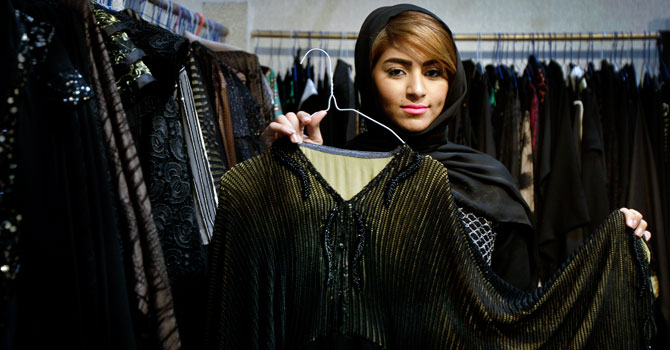
DUBAI: Just a few years ago, Gulf Arab women usually only felt comfortable by showing off their fashion sense at ladies-only at parties or family gatherings.
In public, at least in their home countries, the standard all-black 'abaya' a simple floor-length covering and accompanying head scarf was the only culturally accepted option.
But now, a new generation of abaya designers is giving the traditional garment a twist with choices of fabric, designs and even some expensive bling to allow Gulf women a host of style options.
The basic look of the abaya remains unchanged: black with long sleeves and a flowing form that somewhat conceals the shape of the body.
Gulf culture and government directives encourage ''national dress'' for both sexes: Men wear full-length robes that are mostly white, but include other colors such as beige and blue.
Designers, however, have increasingly recognized the demand for abayas with a bit of extra flair.
It can be as subtle as embroidery on the sleeves and hems or as eye-catching as gems stitched into the fabric.
Top European fashion houses such as Dior, Nina Ricci and Alberta Ferretti have already put their stamps on abayas in the wealthy Gulf market for local woman, known as Khalijiyat, after the Arabic name for the Gulf.
The most expensive abaya so far has been valued at $17.7 million, created by British designer Debbie Wingham and displayed in Dubai in March.
It features different colored diamonds including the world's most expensive and rare, the red diamond.
There are more than 200,000 stitches in 14-karat white gold thread.
Among the Gulf countries, the United Arab Emirates and particularly Dubai is the center of the specialty abaya industry with exports going across the Middle East and North Africa and to some African Muslim countries.
But since the Arab Spring uprisings, the UAE has sharply reduced visas from countries including Egypt, Tunisia, Syria and Libya.
This has led to a steep drop in sales.
Kaleem Khan, a Bangladeshi abaya designer at the Abu Hail Center in Dubai, estimated that sales were down 70 per cent because regular buyers cannot get visas to the UAE.