0
0

ISLAMABAD, June 18: The country has enough reserves to cover dues of the International Monetary Fund (IMF) as most of the debt is owed to international lenders and not global markets.
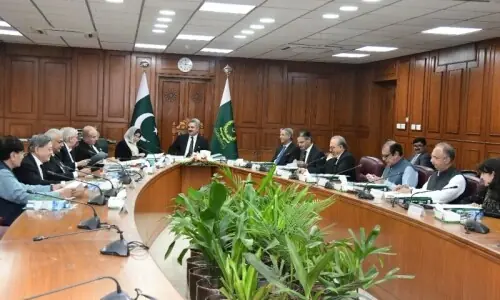
This was said by Governor State Bank of Pakistan (SBP) Yaseen Anwar at the 26th Saarc Finance Group Meeting and Governors' Symposium on the impact of EU crisis on South Asian economies here on Tuesday.
“Our biggest concern right now is the repayment of IMF loans. As of now, we do have more than enough reserves to cover our dues to the IMF,” he remarked.
Our greatest concern would be the impact of a persistent recession in Europe on our current account balance, he said.
“Most of our exports consists of low value added final products and their demand is relatively inelastic. Pakistan has one of the lowest unit prices for these products in the region and most of our trade is actually with other Asian countries therefore our exports will not be significantly affected by a fall in demand from Europe,” he informed.
He said that in this situation, the implications were straight forward, adding: “Demand for our goods and services from the continent will not rise, inflows from Europe to finance our external accounts are likely to be few and far between and our financial system will have to be wary of its exposure to European sovereign securities.”
He went on to add that as investors look to pull out of Europe, they would be interested in this region. As developing markets, we have the potential to offer them a safer, and a higher rate of return on their investments, he opined.
“In the case of Pakistan, there is an urgent need for structural reform before we can be in a position to attract inflows from foreign investors looking to limit their exposure to Europe,” he added.
Talking about remittances, he said that these have grown strongly despite the current slowdown in the rest of the world as well.
The Pakistan Remittance Initiative (PRI), which has been a joint initiative of the State Bank, the Ministry of Finance, and the ministry of overseas Pakistanis, has been instrumental increasing the volume of remittances received by this country.
Addressing the conference, former governor SBP Dr Ishrat Hussain said that the EU debt crisis has had a very little impact in the Saarc economies.
“Our polices have done more harm,” he said while adding that external risks from EU have diminished.
He called upon the regional countries to revisit the issues including subsidies on fuel, goods and fertilisers which were not targeted and widening the fiscal deficits.
He stressed the need to remove the infrastructures bottlenecks and energy shortages, corruption, weak governance and domestic policy uncertainty, social security concerns and social unrest.
Dr Ishrat said that intensification of Euro area debt tension in mid 2012 did cause some weakening of exports across the region, as regional exports fell by 4 per cent in dollar terms.
He informed that a recent IMF study confirms that emerging markets and developing economies (EDEs) and performing better then the advanced economies as most of their inflation are at single digit.
The global GDP is expected to expend about 2.2pc this year while the growth in the EDEs is projected to be around 5.1pc, he added.
Dr Hussain said that South Asian countries have done remarkably well in raising the per capita incomes of their population as they grew by an average 6pc during the last 20 years.
GDP growth rate is expected to resume its trajectory with 5.2-6pc and 6.4pc in the next three years adding that EU economy is expected to stabilise in the first half of 2013 and its GDP growth is projected to turn positive gradually in the second half of 2014.
He called upon the regional countries to develop public-private partnership to minimise dependence on government resources.—APP