0
0

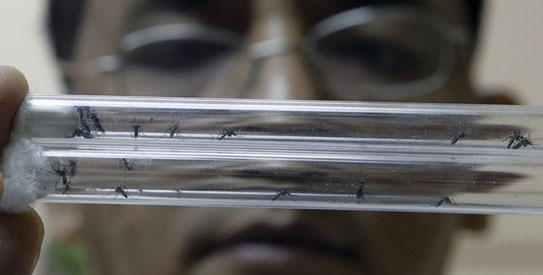
LAHORE: The dengue epidemic is likely to hit Lahore more fiercely this year as scientists and researchers have found recently that one of every three Aedes Aegypti female mosquitoes and Aedes albopictus female mosquitoes are infected with dengue virus.
This was stated by GCU zoology department chairperson Prof Dr Nusrat Jahan on Tuesday while presenting her research paper at a special technical session on dengue control and treatment on the opening day of the three-day 32nd Pakistan Congress of Zoology being organised by the varsity’s zoology department, Zoological Society of Pakistan (ZSP) and Higher Education Commission here.
For research purposes, Prof Jahan said they had collected female mosquitoes from various localities of Lahore and screened them for the dengue virus by using specific monoclonal antibodies. “The results were alarming as they indicated more than 33 per cent infection rate,” she said.
“Recommending biological and hormonal control of dengue, Prof Jahan observed that fumigation and sprays should be discouraged as they were more hazardous than the dengue itself.
She said that “bio-control” was the use of natural enemies, such as Bacillus thuringiensis israelensis (btis) and copepods, to manage mosquito population with a minimum risk to humans, wildlife and the environment. She said that lethal ovitraps and insect growth regulators could also be used to control mosquito population.
About the management of critically ill adult patients of dengue shock syndrome, Allama Iqbal Medical College principal Prof Dr Javed Akram said that dengue fever was not as fatal as was perceived to be; rather, he said, it was the mishandling of patients that made dengue fever fatal.
He also highlighted various clinical aspects of dengue fever.
ZSP general-secretary Prof Dr AR Shakoori said this was biggest and most prestigious international congress ever held in Pakistan as experts from 13 countries, including the United States, Sweden, India, Switzerland and Afghanistan, were presenting their latest innovative work that would cover all major areas of zoology including entomology and pest management, cell biology, molecular biology, bio-informatics, environmental bio-technology, bioremediation, genetics, toxicology, parasitological, microbiology, physiology, paleontology, environmental biology, wildlife conservation, fisheries and marine biology.
ZSP president Prof Dr Afzal Kazmi emphasised on the contribution of young scientists in national development, saying that these congresses were aimed at transferring scientific skill and knowledge to the youth.
GCU vice-chancellor Prof Dr Khaleequr Rahman said a healthy research culture was being developed in the country and such science conferences and meetings were highly critical in this regard.
He expressed pleasure that despite all negative propaganda, more and more international experts were coming to Pakistan and interacting with local experts and youth.
Around 1,100 zoologists from home and abroad are participating in the conference. As many as 650 research papers will be presented during the conference of which almost 20 per cent are on dengue epidemic control.