0
0

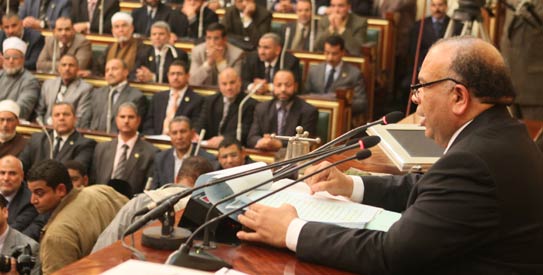
CAIRO: MPs from religious parties took centre stage on Monday as Egypt’s parliament met for the first time since a popular uprising ousted Hosni Mubarak, electing one of their own as speaker of the assembly.
In their first act, the deputies in the Islamist-dominated lower house voted overhelmingly for Saad al-Katatni, a leading member of the powerful Muslim Brotherhood.
A year after the uprising, many Egyptians see the new parliament as the first sign of democratic rule, in sharp contrast to the previous legislature dominated by Mubarak’s party.
“We want to build a new Egypt, a constitutional, democratic and modern Egypt,” Katatni said in a speech after being sworn in.
“Democracy will be the source of our parliament’s power,” he added in remarks greeted with applause.
Egypt’s first free parliamentary elections, which were held in phases between November and early January, saw religious parties clinch nearly three-quarters of the seats.
Katatni, 59, has been serving as the secretary general of the Freedom and Justice Party, the political arm of the once-banned Muslim Brotherhood, which won 47 per cent of seats in the first free elections since the revolt.
“We say to the Egyptian people and to the world that our revolution continues,” Katatni said to more applause.
Outside the People’s Assembly, hundreds of religious partie's supporters greeted the MPs as they entered the parliament, in scenes unimaginable just a year ago when most religious parties movements were banned.
But the exact role of parliament remains unclear, with power remaining in the hands of the generals who took power from former president Mubarak.
“How can we read this oath when we don’t even know if we will be a presidential system or a parliamentary system?” one MP asked during the swearing in.
Hundreds of protesters also gathered outside parliament amid heavy security to press deputies to implement the goals of the revolution, including an end to military trials of civilians, social justice and the trial of officials found guilty of abuse.
Others chanted against the ruling military council and its chief Field Marshal Hussein Tantawi, who served as Mubarak’s defence minister for two decades.
Katatni thanked “the great Egyptian army and the (ruling) Supreme Council of the Armed Forces, which stuck to its promise that it would hold elections that the world could boast about.”
The military has repeatedly pointed to the landmark polls as proof of its intention to hand power to civilian rule, but it has come under intense criticism in recent months for rights abuses and stifling dissent.
Activists accuse the generals of seeking to maintain political control despite assurances by the army that it will cede power to a civilian authority when a president is elected in June.
Before Katatni’s election, the packed and sometimes chaotic first session was chaired by parliament’s most senior member, Mahmud al-Saqqa of the liberal Wafd party.
The deputies were sworn in one by one, pledging to “preserve the safety of the nation and the interests of people and to respect the constitution and the law.”
In a sign of the religious parties’ increasing assertiveness, one ultra-conservative religious MP insisted on adding a religious reference to the oath.
Lawyer Mamduh Ismail took the microphone vowing to also “abide by the law of God,” but he was sharply rebuked by the chair, Saqqa.
“Please stick to the text,” an angry Saqqa urged Ismail, asking him to repeat the oath several times.
Others tried to add “to protect the goals of the revolution” to the oath and received a similar rebuke, during the animated first session which saw several deputies don yellow sashes calling for “an end to military trials of civilians.”
The long-banned Muslim Brotherhood won a crushing victory with 47.18 percent through the Freedom and Justice Party.—AFP