0
0

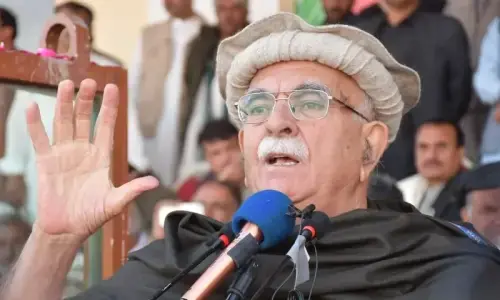
Senator Mir Israrullah Khan Zehri, the former minister of food and agriculture, has a dream.
He dreams that his ministry, which was devolved on June 30, 2011 - the deadline for devolution to be completed under the 18th amendment - will be resurrected.
He may be a minister without a portfolio and no staff - almost all of around 500 staff and officers have been transferred to other ministries and departments - but he dreams on.
Perhaps this is why he continues to occupy his former office in B-block of the Federal Secretariat, along with the staff. And the plaque that declares that this is the ‘Ministry of Food and Agriculture’ is still in place and is well looked after. It is polished and cleaned every day.
Neither is he a man with few supporters. Many of the officials that earlier worked with the ministry echo his views. And while the politicians remain silent out of apathy or fear of a backlash of their party leadership (most parties voted for the 18th amendment), it is the bureaucrats who have been robbed of their posts and their privileges and are the loudest voices in support of retaining responsibilities at the centre.
This is particularly true of the food ministry.
“Under the current situation, there is no system to check food stocks in the country - with the new system one province could be short of a crop that another province could be exporting abroad,” Zehri said, adding a country needs a federal division to ensure food security all year round.
Under the banner of devolution, the minister and officials within the former ministry are pushing for the revival of Agriculture Research Division (ARD) that was abolished in the mid-1990s. At the time, ARD replaced with Pakistan Agriculture Research Council (PARC) and those who worked for the latter now want ARD back.
Not that PARC has been devolved - it has simply been transferred to the ministry of science and technology.
This is not all. The officials of former food ministry said there was a need for retaining three other wings of their ministry: food commissioners, the fertilizer section and the economic wing.
In the former ministry of food and agriculture, there were six commissioners with the responsibility of monitoring wheat, sugarcane, rice, cotton crops, a seventh to oversee the production of minor crops such as gram, maize etc., and an eighth for monitoring special crops such as oilseeds.
After devolution, these commissioners have been transferred to the Planning and Development Division of the federal government but they do not have any work or a workplace for that matter.
“The people in the planning division consider us outsiders,” said one commissioner, as he lounged around in a corner of the B-block, his former office.
The economic wing, which collected data and compiled nationwide production figures, has been shifted to the Statistics Division and, therefore, retained in the federal government.
The fertilizer section, which has also been shifted to Planning and Development, used to compile nationwide data in order to keep the government updated about the fertilizer stock position. (Officials of the food ministry think this too should be brought back.) No wonder then that an official of the former food ministry summarised that “None of the major functions under the ministry of food and agriculture have been devolved to the province; instead they have been displaced.”
Zehri agrees: “It has been more distribution rather than devolution,” as he argued that even departments within livestock such as animal quarantine and deep-sea fishing should also exist at the federal level.” The official from the former ministry added that “The government should be realistic and bring all food-related functions under one roof,” either under a ministry of Food Security or under a re-established ARD.
The quiet moves within the former ministry are being watched with bated breath by others. An official of the finance ministry revealed that officers of most devolved ministries were supporting the establishment of ministry of food security or the ARD in the hope that it would pave way for the revival of other ministries.