0
0

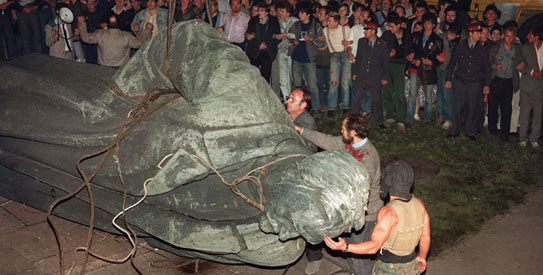
LONDON: They were standing in a close huddle like a knot of naughty boys in the school yard, up to no good, turning silent as I walked past.
Only this was no schoolyard, but the walled Kremlin gardens, and the “boys” were the head of the Soviet KGB, the country's defense minister, the interior minister and the prime minister.
It was indeed the last day of term. The Soviet parliament had gone into summer recess and I was a straggler hurrying through the Kremlin grounds towards Red Square.
I spotted them as I turned a corner, wondering what they were gossiping about, the burly defense minister, Dmitry Yazov, the wiry security chief, Vladimir Kryuchkov, and their two partners in mischief.
Perhaps I should have asked. In those palmy days of 'perestroika', Western journalists rubbed shoulders with the mighty. But in any case, I did not have to wait long to find out.
A month or so later, in August 1991, they toppled their “headmaster”, Mikhail Gorbachev, and declared themselves the rulers of the Soviet Union. When the coup collapsed, they were marched off to Moscow's “Sailor's Rest” jail in disgrace.
It would be wrong to trivialise what happened in August 1991, an event that hastened the collapse of the Soviet Union and disrupted the lives of millions. Three people were killed and many more could have died. For some it was terrifying.
But there seemed to me throughout those three days always something naive and boyishly irresponsible about the “Emergency Committee” the plotters so clubbishly formed to restore their brand of order.
LOOKS LIKE A QUIET DAY
I too, had been an innocent in my way. For months, we Western journalists in our KGB-guarded compound had been discussing the possibility of a hardline coup against Gorbachev.
But what did I write in my closing note before I left the office that warm summer's evening?
“Looks like Monday will be quiet.”
Hours later, as I slept, news of the formation of the emergency committee began to run over the official TASS news agency. Three days of pandemonium, three sleepless nights, began.
On that Monday evening, Soviet Vice-President Gennady Yanayev spoke at a televised news conference explaining how the Geh-Kah-Cheh-Peh (even the acronym they used sounded so snearingly, adolescently awkward) had been forced to act to save the Soviet Union from disintegration.
Gorbachev, he said, was ill at his holiday home and unable to be present. In fact, he was imprisoned there, a warship parked offshore, and, by his own accounts, furious.
There was the thing about Yanayev. Yanayev's hands visibly shook as he picked his way through papers on the desk. The whole nation could see it. His fellow Geh-Kah-Cheh-Peh members sitting alongside him could see it too.
They had, all of them, been naive in thinking the Soviet Union had not changed since Gorbachev began his reforms in 1985 - reforms meant to reverse economic decline masked by superpower status, reforms that eased, if only for a short spring, a fear of authority rooted in generations of political oppression.
They still believed they could just click their fingers and the governing apparatus would snap to attention obediently, knowing just what to do. But when they clicked their fingers, there was not so much opposition as hesitancy, uncertainty, cynicism, weariness, paralysis.
They did not even think to shut down the airports, take control of the telephone system to isolate any opponents. They did not believe it would be necessary.
The Committee issued long lists of decrees, read out on television in deadpan voice by a young woman. They sent tanks to the centre of Moscow, ordered a curfew, made some arrests, but not enough.
RAIN, RAIN, RAIN
On the streets, it was all so unreal. Aged ladies climbed spryly up onto armoured cars and tanks by the Kremlin walls to feed youthful soldiers with sandwiches and sausages. A few thousand gathered with Russian President Boris Yeltsin outside the White House on the banks of the Moscow river.
Then there was the rain. It seemed to rain for three days.
By the Tuesday night, the boys had lost heart entirely. The sick note. I remember filing a story on Prime Minister Valentin Pavlov announcing he was stepping down from the Geh-Kah-Cheh-Peh, for health reasons.
In losing their nerve, they became more dangerous. On the Tuesday night, three men were killed in disturbances not far from my flat. By the morning, they knew it was all over.
Interior minister Boris Pugo, one of those I saw standing around in the Kremlin, sat on his bed wearing his tracksuit, put a gun to his head and pulled the trigger.
The other coup leaders went to the airport. They were flying down to the headmaster's holiday home, no doubt with shaking hands, to offer their apologies and to make their peace.
He would have none of it.