0
0

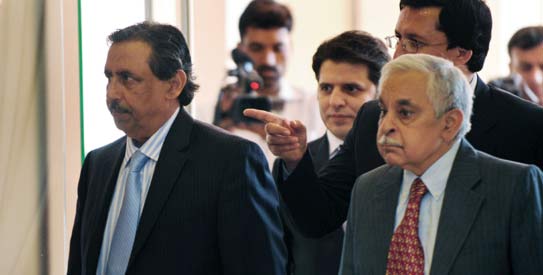
KARACHI, July 4: The Federal Secretary Commerce in a veiled warning on Monday said if India did not stop opposing at the WTO duty concessions given by the European Union to Pakistan, it may once again derail the composite dialogue process between the two countries.
Addressing a seminar on Pakistan India trade jointly organised by the FPCCI and India Pakistan Chamber of Commerce and Industry Zafar Mahmood said there should be a rational behaviour towards resolving issues and assured that he would never like to be part of a hindrance in the promotion of trade relations with India, which should be on a reciprocal basis and fair play.
He emphatically said that there was a lot of difference between what is on papers and what is in reality and added that by giving the Most Favourite Nation (MFN) status is not sufficient alone because its application in letter and spirit is equally important.
The secretary’s remarks were in response to the views of Dr Rajiv Kumar, secretary general Federation of Indian Chambers of Commerce & Industry (FICCI) made at the seminar,
Dr Rajiv Kumar during his observation over trade relations between India and Pakistan earlier said that each time when both the countries made progress in their dialogue and trade negotiations someone casts an ‘evil eye’ which derails the process and bring the negotiations to a sudden halt.
In order to prove that no ‘evil eye’ ever stalled the negotiation process with India the secretary commerce briefly visited the history and said it was the mindset and the commitment, which was needed to keep moving forward.
Citing a recent incident Zafar Mahmood said during his April 27-28 talks with his Indian counterpart it was transpired that for promotion of trade relations it was necessary for both the states to ease the visa policy.
Surprisingly, he said when the Indian High Commission issued new visa policy the first condition laid down for getting a business visa was producing a letter of credit (L/C) by the applicant.
The secretary commerce said now the question is when there was no direct link between the business communities of both the countries, particularly when India has not allowed roving service on cell-phones for Pakistan how could businessmen arrange an L/C for applying for a visa. Similarly, he said under the Saarc arrangements only 100 visas per annum could be issued by each country to their business community members. There should be some rationale because the size and trade volume of India and Pakistan is much bigger than other member countries of the regional bloc.
Zafar Mahmood was highly critical of the Indian stance over EU’s trade concession given on 75 items to Pakistan.
He said that when 27-member countries of the EU agreed to assist Pakistan, whose economy had been immensely suffering from war against terror and last year’s devastating floods, India continues to oppose the package at the WTO where six meetings have been held so far.
As a result of this, he said, waiver from the WTO was still awaited and Pakistani people are suffering because of economic pressure and lack of job opportunities, particularly when business houses have to incur extra cost by meeting foreign buyers’ conditions, who are reluctant to visit Pakistan, he added.
The secretary commerce recalled that during the negotiations with the EU a high official of the European Commission warned that ‘your Pakistan chides India for opposing EU package big neighbour’ will oppose the package at the WTO.
However, he (secretary) told him things had changed but as of today it proved that he was wrong because India continues to oppose the meager concession package of $100 million at the WTO.
Similarly, he said that after Mumbai incident India stopped composite dialogue with Pakistan. However, today Indian officials are admitting that discontinuation of dialogue was a wrong decision.
It was pertinent to note that no prominent business leader from India and even the president of the FICCI attended the seminar. Secretary General FICCI Dr Rajiv Kumar disclosed that he had come to Pakistan to see his sister in Karachi.
From the Pakistani side almost all the top business leaders and the president FPCCI Senator Haji Ghulam Ali, President India-Pakistan Chamber of Commerce and Industry S M Muneer, Triq Sayeed, vice president CACCI, Tariq Iqbal Puri, chief executive TDAP, and Dr Ishrat Hussain, director and Dean of IBA, were present at the seminar.