0
0

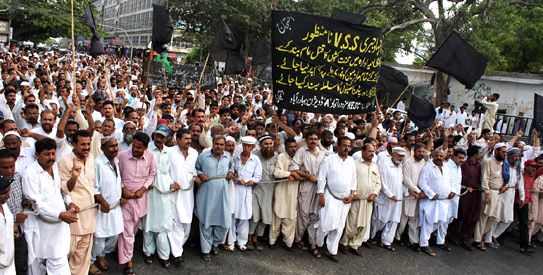
PESHAWAR: Hundreds of Pakistanis took to the streets Thursday to protest against rolling blackouts that paralyse industry and make life unbearable in the searing summer heat.
Pakistan produces only around 80 per cent of its electricity needs and each year as temperatures rise towards 50 degrees Celsius (122 Fahrenheit), furious crowds riot across the country, heaping pressure on the unpopular government.
Police officials estimated that around 1,000 Pakistanis protested in three parts of the northwestern city of Peshawar, where Taliban militants Wednesday bombed a police station to smithereens, killing nine security personnel.
The crowds chanted slogans against the government, blocked roads with stones, bricks and vegetable carts, and set fire to tyres.
“We are fed up with these long power cuts. I go to my grocery store in the morning and keep sweating throughout the day,” said Sohail Khan, 27.
People in towns and cities in the northwestern province of Khyber Pakhtunkhwa face cuts for 12 to 14 hours a day, while rural areas can receive electricity for as little as four to five hours a day.
“My students often pass out in the classroom because of excessive heat,” said local teacher Fazal Ahad.
In Pakistan's biggest city of Karachi, police official Imtiaz Ali said dozens demonstrated in the Landhi neighbourhood, burning tyres and throwing stones at the traffic in their outrage against power utility officials.
Riots to protest against the blackouts are near daily occurrences.
“The worsening supply of power has created a serious law and order situation in the city,” said a senior police official who did not want to be named.
“In most cases people set up bonfires and pelt moving vehicles with stones. At times, protesters have attacked the KESC (Karachi Electricity Supply Corporation) offices, damaged the property and beaten up its employees.”
Pakistan's crippling energy shortages have been blamed on corruption, short-sightedness, debts, a creaking distribution system and a lack of money or refusal to invest public funds in renewable energy as demand grows.
In China last week, Prime Minister Yousuf Raza Gilani called on Chinese firms to invest in his country's energy sector, in a bid to boost a moribund economy hit by massive floods last year and weak Western investment.
Gilani insisted Thursday that the government was taking “all possible measures” to improve power generation.
The government said it was trying to increase investment in renewable emergency resources and would “soon” launch “small, medium and mega size hydro projects in the country to eliminate power shortage in the long run”.
Tabish Gauhar, chief executive officer at KESC, called on the government to take the matter into its own hands.
“The government has a responsibility to protect the power supply system, KESC assets and personnel, in order to release the helpless consumers from the misery of prolonged outages because of sabotage and violence,” he said.