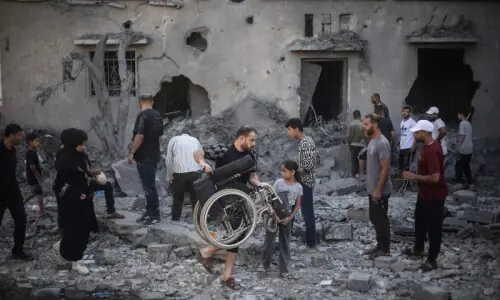
Titles included descriptions such as 'Hybrid figure in fibre glass as installation,'—perhaps double dome theory for Suleiman mosque—'Labouring hands of an unseen woman' and 'Triangular canvas with parts of a donkey cart'. The painting, 'Fallen man' was among the intriguing 'visions' that made one stop and think. There was this dark trousered figure, with head buried in rubble, legs in the air and in the distance the omen of more rubble to come.
One certainly enjoyed discussing the artist's work with art enthusiasts during the show and there were many keen, personal interpretations to ponder. The artist was in great form, rising above his disabling illness to interact with visitors. He spoke of his student days at CIAC with Ali Imam as principal, and his class fellow the artist, gallery owner, Shakil Ismail who arranged his exhibition. “I must thank him for arranging this beneficiary show in my difficult time,” he said.
Saleem, who graduated from CIAC in 1983, has a considerable record of solo exhibitions to his credit. He began by making installations in the interior of Sindh and filming them, much to the entertainment of the local inhabitants. He began an exquisite series of old colonial houses, the 'Arris,' or sharp ridge formed when two surfaces of brickwork meet, delineated with the detail found in classic miniature work. Imam had a huge market for these artworks but Saleem baulked; he was not into the market, and preferred the freedom of experimentation. Years were focused on the study of archeology and Arabic, widening and enriching his aesthetic output.
Saleem still remembers the “great remarks to record” in a lecture given by the Gregory Minissale in 1988. “At last somebody in publication recognised me as a sculptor as well,” he said. As Minissale explained at a lecture of contemporary Indian Art, and later wrote in the leading art paper of that time “From among the Indian artists, their sculptors represented the height of experimentalism, perhaps demonstrating that besides Mansoor Salim and Shahid Sajjad, Pakistan may well have been left behind when it comes to experimentalist or abstract sculpture.”
Using the few daily hours of ability to paint that his medicines allow him, Saleem is still the fascinating and enigmatic artist he has always been, fuelled by his 'flashes,' supportive friends and family and the regard of a number of art enthusiasts.
In Saleem's work an art language of diverse symbols gives clues to the artist's inner journey though he speaks of his imagery as signs for future scientists to unravel.