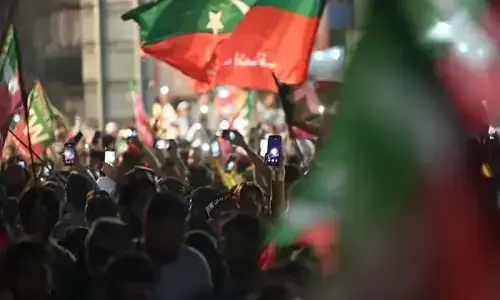
THE sad truth is that a popular movement or agitation has never brought down a Pakistani government before. It is not going to do so in this season. If the only threat to the empire of the heavy mandate was from the 19-party alliance, now expansively dubbed the Grand Democratic Alliance, Mian Nawaz Sharif would have little to fear. His real concern is different and arises from another quarter: his relationship with Rawalpindi which, not to put too fine a point on it, is fraught and tense because of the great Kargil fiasco.
The public owning of responsibility is a tradition which has never existed in Pakistan. If there was no night of the long knives after Pakistan was dismembered in 1971, it is too much to expect that there would be an outburst of honesty or blood-letting because of Kargil in 1999. The Islamic Republic in crisis has always seen the ruling elites closing ranks and protecting their own so as to pull a blanket of discretion over even their greatest follies.
There is a telling and crucial difference this time. Kargil has dealt a blow to the unity of the governing class, driving a wedge between the heavy mandate and Rawalpindi. While both have had their fingers burnt, both are trying to put the blame for this fiasco on the shoulders of the other. In the shades of Islamabad this is the real cat-and-mouse game being played. Compared to this game the opposition agitation in the rest of the country, for all its sound and fury, is a side-show.
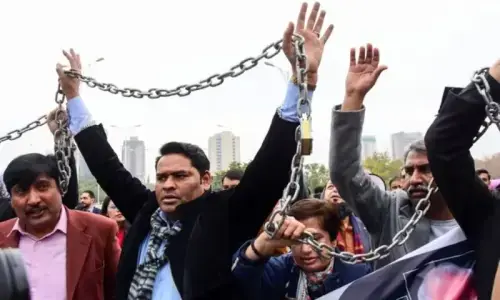
To be sure this agitation is not without significance, for the more it picks up steam the more rattled and disoriented becomes the heavy mandate. But it is not of decisive importance. The key to political change has never been in the hands of the people.
The great objection being levelled at the opposition alliance is that it does not have a common programme or a single candidate for prime minister. This objection is pointless. Even if the present opposition had Karl Marx to write its manifesto, and Akbar the Great as its prime minister-in-waiting, it would still make no difference.
Change in Islamabad, even when undertaken in pursuance of a constitutional clause such as the now-defunct Article 58(2)b, has always occurred after a nod or signal of active support from Rawalpindi. Any political hopeful forgetting this elementary principle of Pakistani politics is not likely to carry his ambitions very far.
Mian Nawaz Sharif should know the truth of this since the inexorable rise to glory and power of Ittefaq Inc. is a direct outcome of military benevolence. Without generous help from that quarter, Nawaz Sharif would have been another industrialist living the good life in Lahore.
Nawabzada Nasrullah Khan also knows this eternal verity of Pakistani politics. Although he has spent his life putting together political alliances, some of them quite amazing, against autocratic regimes (except for that one time when he found himself supping at General Zia-ul-Haq's lurid table), who should know better than him that as often as not democratic movements have served as the enabling instruments of dictatorial ambition? Thus it was in 1968-69 when the movement against Field Marshal Ayub Khan culminated in the coup d'etat of General Yahya Khan. Thus again in 1977 when General Zia-ul-Haq stole the fruits of the agitation against Zulfikhar Ali Bhutto.
There are of course fearless knights in Pakistan, and not a few of them in the English press, who angrily declare that never again will they tolerate another adventurer. If only wishes were horses and adventurers could be stopped from riding into power by searing columns in the English language press.
On stud farms, as a ficionados of equine matters are well aware, mares are put in the right frame of mind by horses called 'testing ponies'. Only when things reach the desired pitch does the stallion who is supposed to do the final honours brought on the scene. The pity of democratic politics in Pakistan is that opposition alliances, in all sincerity and with the best intentions in the world, have played the role of testing ponies to Bonapartist stallions. When things get hot, someone else appears on the scene to carry the prize away. This is not to disparage democratic politics but merely to point out one of the structural defects of our Republic. What's more, till such time that the Republic's stables are thoroughly cleaned (by what Herculean process we do not know) this structural defect will remain.
Indeed, if George Orwell were to rise from the dead and write a book on Pakistan he would have to call it Stud Farm not Animal Farm. But if the opposition has problems, Nawaz Sharif has problems of his own which are of a much more serious nature.
How will the stallions behave? That's his problem and not what pranks the testing ponies of the opposition are getting up to. Why then curse or belittle the opposition parties as Mian Nawaz Sharif and his loudspeakers are increasingly doing? And what point in working the crowds in Santnagar, Mian Azhar's home base in Lahore? If Mian Azhar was the only threat which Nawaz Sharif faced, he could play cricket to his heart's content and resume his foreign travels, now sadly interrupted because of his domestic preoccupations. From all of which the conclusion can be drawn that instead of tilting the windmills, the rattled barons of the heavy mandate should be seeing the larger picture and trying to put their own house in order.
But this precisely is the problem. It is difficult changing course in mid-stream. If a particular style of government is confused and bumbling, there is no instant formula which can turn it overnight into a model of vigour and clarity. What Dostoyevsky said about the second half of a man's life - that it is mostly a repetition of the first half - is also true of statecraft. If you do not have this gift in you, acquiring it is difficult. That is why it will take more than magic to make the second half of the heavy mandate look any different from what we have seen of it in the first half. So Nawaz Sharif's problem is not that he should become a more efficient and effective ruler. That is not going to happen. His problem is stark in its simplicity: how to disperse the testing ponies and keep the stallions tethered firmly in their proper place.
Therein lies the rub. In the giant stables in Rawalpindi where Pakistan's champion stallions are kept, the mood is dark; some would go so far as to say even dangerous. One indication of this is the almost permanent scowl that has come to sit on the army chief's face. A carefree man before Kargil, he now looks visibly unhappy. Niaz Naik has only made matters worse. Whatever he may have meant to convey, his remarks in Karachi will be taken by the army high command as another attempt at putting the entire blame for Kargil on its shoulders while absolving the civilian leadership of all responsibility.
Naik has said that because of poor coordination among those planning the Kargil venture, the prime minister was not fully in the know of it, the implication being that had he known what was going on he would have put a stop to it - which is to put more faith in the prime minister's powers of observation than even his partisans might be willing to allow. Naik has gone on to say that back-channel contacts between India and Pakistan (of which Naik was a part from the Pakistani side) were leading to some sort of an agreement on Kashmir but that the possibility of any progress was spiked by the fighting in Kargil.
This is a travesty of the facts. Whatever secret contacts there were between India and Pakistan were post and not pre-Kargil and for Naik to imply anything different is irresponsible, especially at a time when there is tension and growing distrust between Rawalpindi and the heavy mandate.
In private, senior army officers are not above conceding that the army high command was guilty of serious errors of judgment about the Kargil expedition. What they resent are attempts to put the entire blame for this fiasco on the army command while giving a clean chit to the prime minister. This too is a travesty of the facts. The PM was in the know from the beginning.
I have been accused by friends of writing about Kargil endlessly. I write about it not because I am fond of the subject but because Kargil is stuck in the throats of the civilian and military leaderships and unless they can get it out from there it will keep causing problems all around. In any other half-mature country the government would have taken the lead and owned up to the blunder committed, asked for some sort of public forgiveness and then tried to get on with life. But this would have required a breadth of vision and a largeness of heart that on the political stage are nowhere to be seen.
This is precisely why the disease instead of being cured continues to linger. Since it lingers the big question remains: will the sullen mood that can be felt in Rawalpindi pass or will it gel into something harder? To know the answer to this question is to understand how Pakistani politics will unfold in the critical months that lie ahead.