ISLAMABAD, July 26: While the new code of conduct introduced by the Election Commission of Pakistan (ECP) is commendable but implementing the code is where the real challenge lies.
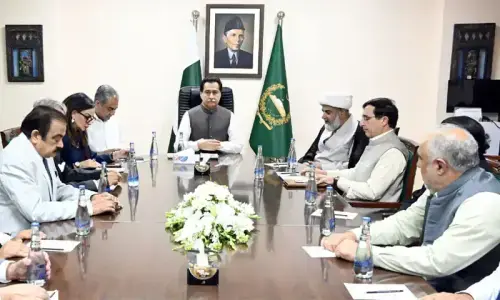
This was stated at " Pakistan's democratic transition: challenges and opportunities,” a roundtable interactive session, comprising members of civil society, media and the development sector, organised by Jinnah Institute (JI).
Opening the session for discussion, director policy and programmes at JI, Raza Rumi spoke of the challenges and 'pitfalls' of the upcoming elections, which include electoral reforms, their implementation and the addition of new voters to the balloting system.
Following up on Mr Rumi's comments, Sarwar Bari from Pattan, spoke of electoral reforms in the light of the new code of conduct introduced by the ECP.
He emphasised the need for the implementation of the code, which according to his most recent experience in NA 151 election in Multan, was anything but kosher, as some of the rules were violated. Therefore, it is important for civil society and media to strictly monitor the electoral process.
Speaking on media's role, senior journalist, Mohammad Malick highlighted some of the limitations of the media — as limitations are built into the nature of the profession — stating that only when the election schedule is announced can one "roll with events”.
He expressed his dismay with the over-expectation with the media, which is connected to the electronic media — having invaded the privacy of the citizen; now the average citizen expects the media to solve all their problems.
Mr Malick further said in a candid manner that he considers media people not journalists but 'generalists'.
"We might be able to ask all the right questions but not necessarily have the right answers," he said.
"We are not crusaders. Our job is to inform and discuss, not reform. Reforming is the job of politicians."
On the subject of reforms and some of the challenges that will be faced in the upcoming elections, social activist and academic, Aasim Sajjad Akhtar talked about the dangers of a 'divided polity,' when people living in different parts of Pakistan think differently and end up voting differently.
Columnist and a prominent figure on social media, Marvi Sirmed, expressed her utter frustration with an urban centric media which is in "collusion" with the judiciary.
As a result, important issues get muddled and the nation's attention span gets monopolised in superficial debates like 'judiciary vs executive' which does not affect the life of the average citizen, agreed most of the participants.
The discussion for a few minutes went off track, when anchor person Arshad Sharif and Mohammad Malick — in a classic talk show showdown — got ensnared in their own words, over media ethics.
Arshad Sharif stated that there needs to be editorial control on content but Mr Malick was of the point of view that the editor should be independent to make his or her decisions.
Mr Raza Rumi salvaged the situation by stage-engineering the moment and passing the discussion back to Mr Bari.
Mr Bari in his closing comments struck an optimistic note, assuring that whatever the challenges in the next general elections, they can all be overcome.
He quoted the example of South Korea where the situation was worse than Pakistan but through staying the course and persistent reforms the electoral process was revamped.