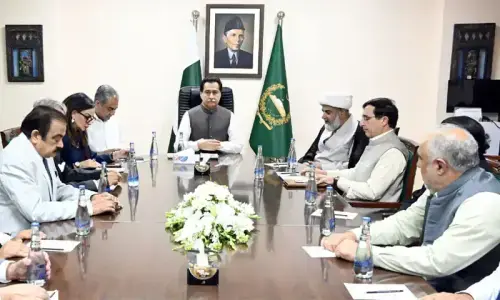
THE Saudi king has called a summit of Muslim leaders for next month to address risks of ‘sedition’ within Muslim countries. It is not yet clear if this will be a purely Saudi-led initiative, or if it’ll happen under the Organisation of Islamic Cooperation’s aegis. Over the past few years, confronting change from within has become the biggest challenge for Muslim-majority states. However, even though the events of the Arab Spring have severely shaken the status quo, many Muslim autocrats remain in a state of denial. First and foremost, that is about clinging to power in a world that is crumbling around them. As in the case of Egypt, Middle Eastern rulers rallied to Hosni Mubarak’s support at first, frightened by the possible repercussions for them if a symbol of the old order collapsed. But, as in the case of Bahrain and Syria, sectarian dimensions have also crept in.
The lack of fundamental freedoms is what is driving the fury and anger against Muslim rulers. Apart from a handful of democracies, Pakistan — imperfect as it is — being among them, most Muslim-majority nations are either ruled by absolute monarchs or strongmen in republican garb. Democracy and representative rule need to be gradually structured into the systems so that people don’t take to the streets or, as in Syria’s case, take up arms and seek to violently overthrow the system. The often violent suppression of dissent in many Muslim countries has also been citied as a key factor behind the growth of extremism and terrorism. The mode of ruling countries through families and clans needs to be reconsidered. If the meeting in Saudi Arabia can succeed in discussing meaningful reform for the people’s welfare, it’ll be a considerable achievement. If it is just another OIC-like talk shop, or worse, an attempt to protect Muslim autocrats, the masses shouldn’t expect much from the summit. The proposed meeting also raises questions about the OIC’s utility, for the pan-Islamic body has been a perpetual underachiever. In short, Muslim leaders can choose to address and accommodate change, or wait for the anger of the masses to boil over into the streets.