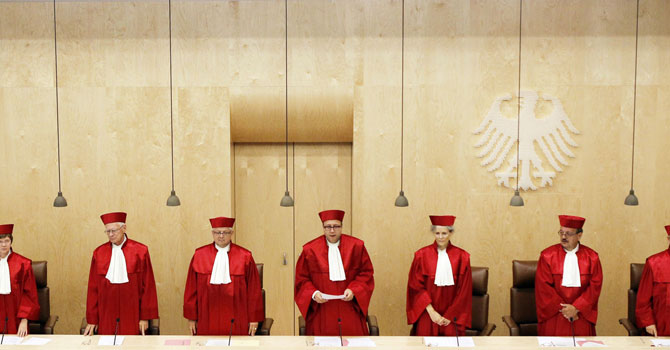
BERLIN: Germany's Constitutional Court will keep Europe waiting until Sept. 12 for its verdict on whether the new tools for fighting the euro zone debt crisis comply with German law or violate parliament's right to decide on national budget issues.
Resisting pressure from politicians and markets for a swift approval of the permanent bailout scheme (European Stability Mechanism) and the fiscal pact for budget discipline, the court said on Monday it would announce its verdict in nearly two months' time.
There was no immediate reaction from the German government, but Finance Minister Wolfgang Schaeuble said after last week's public hearing that he hoped for a ruling before the autumn.
Constitutional Court president Andreas Vosskuhle said during last week's public hearing into complaints that the euro crisis tools are unconstitutional that the court might opt for a “very thorough summary review”, which could take up to three months.
“The constitutional court seems to be one of the few European institutions that takes some time in the euro crisis,” said ING economist Carsten Brzeski.
“I believe September is still fast enough to keep markets from falling into turmoil.”
Constitutional experts say they expect the court based in the southwestern city of Karlsruhe to permit ratification of the ESM and fiscal pact, but possibly signal that Germany cannot cede any more sovereignty to Brussels without constitutional changes probably requiring a referendum.
The ESM, which would boost the firewall against debt crisis contagion to 700 billion euros, had been due to come into effect on July 1.
It needs ratification by countries representing 90 per cent of its capital to be implemented - meaning it cannot be launched without Germany, whose parliament has already approved both pieces of euro crisis legislation by a large majority.
The court last week heard complaints from groups including eurosceptic academics, concerned citizens and some lawmakers from Chancellor Angela Merkel's own coalition that the ESM and fiscal pact violate German law by taking away responsibility for the budget from parliament.