RAWALPINDI: Pakistan's military strongly denied on Thursday a BBC report that alleged the Pakistani military, along with its intelligence arm, supplied and protected the Afghan Taliban and al Qaeda.
A number of middle-ranking Taliban commanders detailed what they said was extensive Pakistani support in interviews for a BBC Two documentary series, the first part of which was broadcast on Wednesday.
A former head of Afghan intelligence also told the programme Afghanistan gave Pakistan's former president, General Pervez Musharraf, information in 2006 that Osama bin Laden was hiding in northern Pakistan.
The former al Qaeda leader was killed in the same area by US Special Forces in May this year.
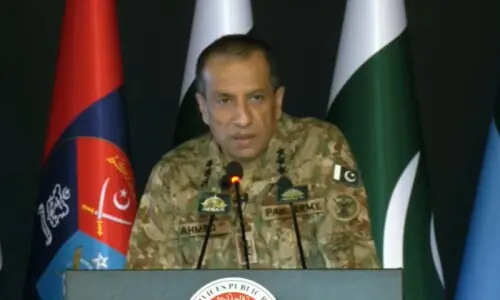
“We consider that this report is highly biased, it is one-sided, it doesn't have the version of the side which is badly hit or affected by this report,” Major General Athar Abbas, spokesman for the Pakistani military, told Reuters.
“So therefore, other than that, it's factually incorrect.”
One Taliban commander, Mullah Qaseem, told the BBC Pakistan had played a significant role in providing supplies and a hiding place for Afghan Taliban fighters.
Abbas denied the claim, questioning Qaseem's credibility.
He said the head of Pakistan's spy agency, the Directorate of Inter-Services Intelligence (ISI), had already said “not a single bullet or financial support” had been given to groups named in the BBC report.
The United States has long suspected Pakistan, or elements within the ISI, of supporting militant groups in order to increase its influence in Afghanistan, particularly after Nato combats troops leave in 2014.
In September, Admiral Mike Mullen, then the top US military officer, accused Pakistani intelligence of backing violence against US targets including the U.S. embassy in Kabul.
He said the al Qaeda-linked Haqqani network, blamed for the September, 13 embassy attack, was a “veritable arm” of the ISI.
Pakistan denies the US allegations.
Pakistan supported the Afghan Taliban before the September 11, 2001, attacks on the United States.
It was one of only three countries to have diplomatic relations with the group.
Abbas said the number of attacks against the ISI by the Pakistani Taliban - about 300 ISI officials have been killed in bombings - was proof the ISI did not support militants.