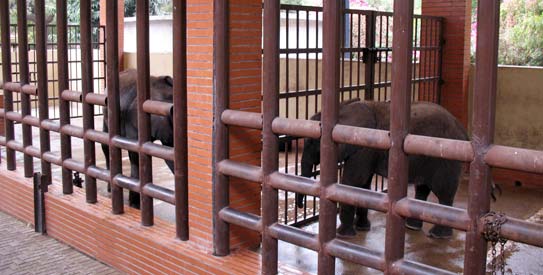
KARACHI: Madhubala and Madam Noor Jehan lumber around their rooms in the compound, separated by a steel cage. It’s an overcast afternoon, and they seem grateful to not have the sun shining down on them, as is typical in Karachi. Madhubala takes a bathroom break, as Noor Jehan tries to grab her attention … by poking at her with her nose.
Excited children and women gather around the railing, trying to get a closer look at the duo. Madhubala and Madam Noor Jehan are the new elephants at the Karachi Zoological Gardens. The caretaker of the elephants, who did not wish to be named, shamefacedly admits to naming these two African elephants that are currently under training to adapt to their new environment. “We’re teaching them to say salaam and get used to the crowds. They’ve come from a different environment. We earlier had an Asian elephant who was familiar with the environment, so it’ll take time for these two to adjust.” Their caretaker was also in-charge of the previous elephant that died at the zoo some years ago.
Formerly known as the Gandhi Gardens, the Karachi Zoo has been in the press for reasons other than positive. Spread out over a vast area in the heart of the city, scores of animals have died here, and frequent reports emerge about the standards of hygiene, nourishment and health care provided to the animals. Yet, despite the negativity that dogs the Karachi Zoo, hundreds of women have come here today, a Wednesday, designated as a women’s only day at the zoo, accompanied by their families. However, not all are happy with the status quo.
“I’ve been coming here after ten years, and have brought my granddaughter,” says Naima, “but the zoo was much better earlier. Now, it is just dirty and there aren’t that many animals either.”
While the zoo is relatively well-maintained, with leafy trees overlooking wide paths, and helpful signs everywhere to help one navigate the zoo, signs of neglect by the zoo administration abound. The stench in the air is overpowering – animal waste, food and stale urine linger in the air. In the enclosure dedicated to rosy pelicans, the pond was covered with algae, and the water resembling a murky shade of green. A plastic bottle of water and empty juice cartons had been hurled inside the pond, and with no caretakers in sight, no one appeared to have been tasked to remove them. In the enclosure for ducks, storks and other birds, callous visitors had thrown plastic bags inside, a potential health hazard to the feathered inhabitants of the area. The lions are sluggish and unkempt, and a lonely Bengal tiger ignores his visitors and gnaws on his lunch.
At the reptile enclosure, snakes and a mongoose are kept in small glass cages. The attendant at the reptile enclosure says that he has heard that more snakes will be arriving soon, and one does hope that they are kept in more attractive conditions – the glass cages are dirty, and information about where these snakes were captured from, is missing.
But where the neglect leaves one wanting to call PETA (People for the Ethical Treatment of Animals) at their earliest convenience, the pride of the Zoological Gardens is the Mughal garden – manicured lawns, shaded with palm trees and a pool of water, designed in the style of the Mughal gardens across the subcontinent, leave one sighing with pleasure. Except that the garden is kept under lock and key – one can only glimpse at it through the gate.
Rukshar, a 13-year-old girl, pouts, “The rides are nice. And [even] the elephants. I don’t like anything else, and the nice garden’s is locked up.” Her mother, Munira, says she brings the children here on Wednesday because of the women’s only rule, and so that they can enjoy themselves. “We have been coming here for ten years.” When asked whether it has gotten dirtier, Munira sounds puzzled. “Well, it was always like this,” as if to imply that one was not expecting conditions to ever improve.
Numerous attempts to contact the zoo administration to answer inquiries about the state of the zoo were in vain, and were met with responses of “the director is on rounds” or “the director is in a meeting”.
Visited by thousands of people every year, the Karachi Zoological Gardens provide the tired, harassed citizens of Karachi a venue to breathe in fresh air, and look at the animals that have been imported or captured from within Pakistan. One does hope that the zoo authorities will focus on keeping the animals in better conditions that the prevalent state, so that the visitors can not just be enthralled by the animals in the zoo, but also be proud of the way they are treated.
Huma Imtiaz works as a freelance journalist and can be contacted at huma.imtiaz@gmail.com