NEW YORK, Feb 22: The tale of Pakistan’s textile quota or tariff reduction on import of apparels to the United States, which did not materialize to the expectations, speaks volumes of the protectionist US textile and apparel manufacturing industry that holds sway over the Congress and the White House.
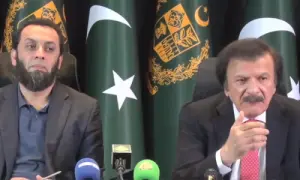
At the end of President Musharraf’s press conference at the Pakistan Embassy, Commerce Minister Abdul Razak Dawood came up to the reporters to inform them that he was not “satisfied” with the market access package for Pakistani textiles announced by the White House a day earlier.
Mr Dawood who had been in Washington week before the President’s visit here had high hopes of securing sweeping tariff and quota relief for the country’s textile and apparel industry, which saw orders from its biggest customer — the United States — dry up after the attacks.
Initially the Bush administration was pushing for a $1.6-billion package, but following a compromise with a Congressman from South Carolina, Jim Demint, whose constituents would have been impacted the most by the deal, the package dwindled to $142 million.
According to a report at first, the US administration appeared receptive. It quietly pressed Congress to take up legislation to fulfil Musharraf’s request amid warnings from Pakistani trade groups that unless orders returned to pre-Sept 11 levels, up to 2.5 million jobs in Pakistan could be lost, undermining efforts to turn the country into a moderate Islamic state.
But when US commerce undersecretary for international trade, Grant Aldonas, presented Pakistan’s proposal to key lawmakers from textile-producing states, the reaction was hostile. They argued the US textile industry was already experiencing its worst economic crisis since the Great Depression and would suffer heavy job losses if low-priced Pakistani products flooded the US market.
Bush had little choice but to back off. The chairman of the powerful House Ways and Means Committee, California Republican Rep. Bill Thomas, told the White House he would not be able to move legislation authorizing tariff reductions for Pakistan.
When the Pakistani delegation was first presented with the offer, they “were very angry,” a US official said.
According to several US sources, the Pakistani negotiators literally laughed at Washington’s offer. A Pakistani official disputed that account, saying Dawood did not laugh and told Aldonas: “We feel you can do better than this.”
But when Musharraf pressed the issue with Bush, DeMint said Bush “told the Pakistani president, you’d better accept this because it’s all we’re going to do.”
FINANCE MINISTER: While Mr Dawood expressed his unhappiness with the package, Finance Minister Shaukat Aziz was elated to say the least about the $1 billion in debt write-off. Although the relief package as envisaged in the White House, paper is not final until the US Congress passes the bill procuring $200 million. So how doers $200 million become $1 billion in write-off is a tricky subject explained by Finance Minister at his press conference here and then in Islamabad. Pakistan’s Ambassador Maleeha Lodhi also took a stab at explaining the budget rigmarole which is like this:
“The US administration is committed to write off one billion dollars debt for Pakistan. It will be for the US Congress to appropriate funds to enable the administration to write off the debt. Debt write-off has budgetary impact, therefore, the amount at the present net value of the debt is $200 million, which will be needed by the administration to retire the debt. You pay debt over a period of time and you calculate the net value. Hence the Congress has to appropriate $200 million to enable the administration to complete the process.”
For the finance minister the news from the credit ratings agencies — Moody’s and Standard and Poors — in New York were also a good omen for Pakistan. But there was a caveat “if all things remain the same.” His hope that there is no other terrorist act and India does not launch an attack, which could then undermine any progress that has been made so far.
LODHI: Sparking of Ambassador Lodhi, she will be Pakistan’s longest serving Ambassador in Washington next month, which translates to five years and three months. Only Lt Gen Ejaz Azim under Zia-ul-Haq served that long. Ms Lodhi’s stint though was in two parts once she was former prime minister Benazir Bhutto’s envoy in Washington, after Ms Bhutto was dismissed in November of 1996 she was asked by the then president Leghari to continue until elections in February of 1997. She was again appointed Ambassador by Gen Musharraf in November of 1999.
During Gen Musharraf’s visit to Washington US lawmakers who have become accustomed to her face on the Capitol hill reportedly heaped praises on her. She has seen Pakistan’s relations with Washington hit the lowest of lows to a new high now. Ms Lodhi, one believes, intends to go back to Pakistan in October.