Indian cabinet approves contentious nationality bill
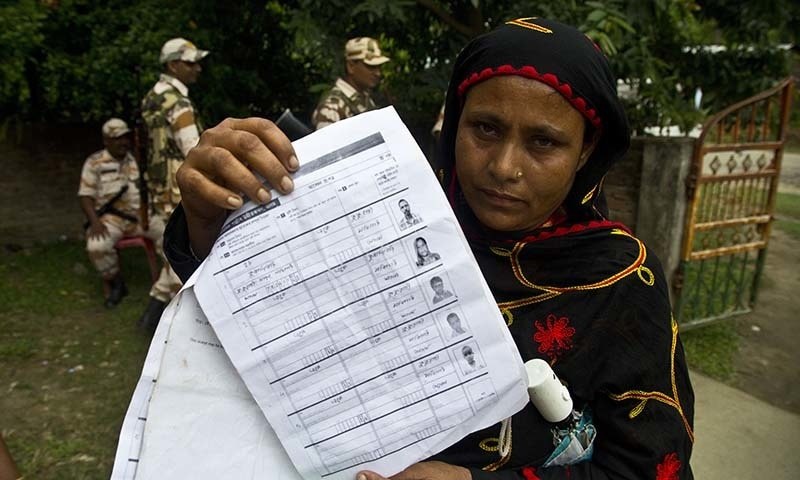


NEW DELHI: India’s cabinet signed off on Wednesday on legislation that stands to give citizenship to certain religious minorities but not Muslims, in what critics say is a fresh attempt to sideline the 200-million-strong Islamic community.
Prime Minister Narendra Modi’s Bharatiya Janata Party (BJP), re-elected in a landslide in May, has long been accused of following a “Hindutva” agenda favouring officially secular India’s majority Hindus.
The amendments to the six-decade-old Indian Citizenship Act, approved by Modi’s cabinet on Wednesday, could go before the lower house of parliament as soon as this week.
The bill would grant nationality to Hindus, Buddhists, Sikhs, Christians, Jains and Parsis fleeing persecution in Muslim-majority Bangladesh, Pakistan and Afghanistan even without any documentation.
Modi’s party has said that Muslims are not included because they are able to take refuge in Islamic nations across the globe.
Senior minister Prakash Javadekar told reporters on Wednesday that the legislation would follow the principles of “natural justice” and is “not against anyone”.
Modi government tried to get similar legislation passed in its first term but failed to garner enough support in the upper house, and it is unclear whether it would succeed there this time.
Apart from stoking unease among Muslims, the proposed changes have also provoked anger in north-east India that for decades has seen major influxes of people of different religions — including Hindus.
Modi’s right-hand-man, Home Minister Amit Shah, held talks with representatives from the region on Tuesday over their concerns.
Shah has been vocal in pushing through the bill that he says is aimed at “saving the lives” of persecuted religious communities in neighbouring Muslim-majority countries.
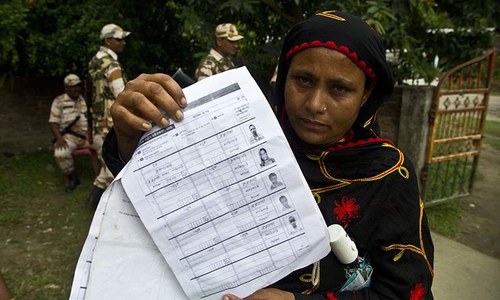
He has also proposed a “national register of citizens” that he said this week would see “each and every infiltrator identified and expelled” from India by 2024.
Shashi Tharoor from the main opposition Congress party told reporters on Wednesday that the bill “violated” the basic idea of a secular India as pushed by Mahatma Gandhi.
“Those who believe that religion should determine nationhood... that was the idea of Pakistan,” Tharoor said, calling the legislation “fundamentally unconstitutional”.
“It is simple. Citizenship CANNOT be determined by or linked to religion,” tweeted Sitaram Yechury, a senior politician from Communist Party of India.
Under Modi, the Islamic-sounding names of several cities have been changed, while some school textbooks have been altered to downplay Muslims’ contributions to India.
There has been a string of lynchings of Muslims over cows, sacred for many Hindus, and other hate crimes including Muslims forced to perform Hindu chants.
In August, Modi’s administration also rescinded the partial autonomy of Jammu and Kashmir, the only Muslim-majority region under Indian occupation, in what his government claimed was a measure aimed at boosting the local economy and rooting out corruption.
The Citizenship Amendment Bill (CAB) was first introduced in 2016 by the Hindu nationalist government of Prime Minister Narendra Modi but was withdrawn after an alliance partner withdrew support and protests flared in India’s remote and ethnically diverse northeastern region.
Critics have called the proposed law anti-Muslim, and some opposition parties have also pushed back, arguing citizenship cannot be granted on the basis of religion.
Published in Dawn, December 5th, 2019