IMF okays $6bn package to ‘foster strong growth’


 29
29


WASHINGTON: The Executive Board of the International Monetary Fund (IMF) on Wednesday approved a $6 billion bailout package for Pakistan and immediately released $1bn to ease a sustained pressure on the country’s foreign exchange reserves.
Read: Pakistan reaches agreement with IMF, to receive $6 billion over 3 years
The package, which supports the government’s efforts to revive the country’s ailing economy, includes a phased release of the additional aid over a 39-month period. The IMF will also conduct quarterly review of Pakistan’s performance over this period.
“IMF Executive Board approved today a three-year US$6 billion loan to support Pakistan’s economic plan, which aims to return sustainable growth to the country’s economy and improve the standards of living,” IMF spokesperson Gerry Rice said on Twitter.
“The country’s economic plan seeks to return sustainable growth to the economy by adopting reforms to foster stronger and more sustainable growth,” he added.
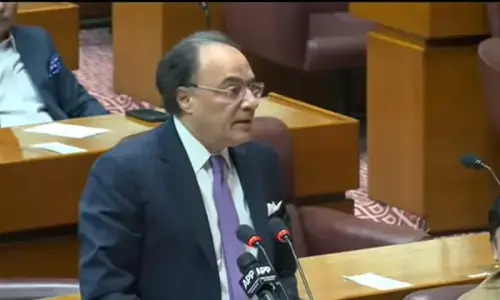
Adviser to the Prime Minister on Finance Abdul Hafeez Shaikh also went to Twitter to confirm the package. “IMF Board approved a $6 billion Extended Fund Facility (EFF) for Pakistan to support our economic reform programme,” he wrote. “Our programme supports broad-based growth by reducing imbalances in the economy. Social spending has been strengthened to completely protect vulnerable segments.”
Immediately releases $1bn to ease sustained pressure on Pakistan’s foreign exchange reserves
Dr Shaikh also said that the government’s “structural reform agenda of improving public finances and reducing public debt through revenue reforms is a key part of the programme”.
He said that the IMF support “bodes well for the country and is a testament to the government’s resolve for ensuring financial discipline and sound economic management”.
The approval follows an austerity budget that the Pakistan Tehreek-i-Insaf government unveiled in parliament last month, committing itself to major expenditure cuts and improved tax collection to reduce seven per cent budget deficit.
In May, Pakistan and the IMF reached a staff-level agreement on a new three-year, $6bn bailout package following months of negotiations.
The accord, which was approved by the IMF board of directors in Washington on Wednesday, aims to shore up Pakistan’s public finances and stabilise its slowing economy.
The long-delayed package is Pakistan’s 13th bailout since the late 1980s.
Earlier on Wednesday, Minister of State for Revenue Hammad Azhar said a deal with the IMF would open up the doors of the international market for Pakistan.
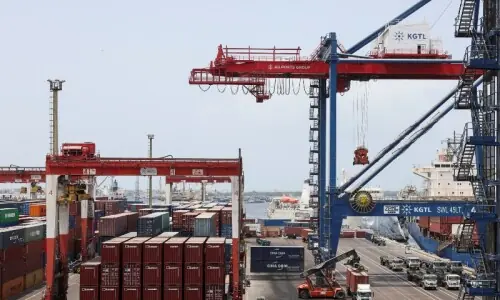
Talking to a private news channel, he said Pakistan was also negotiating a programme with the Asian Development Bank for a state-of-the-art, transit and cargo facility at Torkham and Chaman borders.
To demonstrate its commitment to the austerity drive announced with the budget, the government slashed natural gas subsidies on Tuesday, causing prices to jump by some 200pc.
The reforms include raising interest rates to curb the country’s 9 per cent inflation and devaluing the rupee to improve exports and reduce imports to bring down the current account deficit of some $11bn.
These measures are aimed at stabilising Pakistan’s volatile economy, although they may dampen growth in the short term.
Economists warn that such measures could cause a short-term rise in the cost of living while a clampdown on tax evasion could also hurt the government’s popularity. But they also point out that the current ruling setup has a mandate until 2023, which gives it enough time to overcome the fallout of these austerity measures and benefit from the long-term economic sustainability the reforms could bring.
The Wall Street Journal, however, noted that Prime Minister Imran Khan’s plan to jolt the country’s economy into shape comes “potentially at the expense of the agenda that helped him get elected”. The prime minister, who took office in August last year, has promised to improve the economy and provide more jobs.
The IMF said that the deal with Pakistan involves “economic policies that could be supported by a 39-month Extended Fund Arrangement (EFF) for about $6bn”.
It said the package includes “an ambitious structural reform agenda” to boost growth, which the lender says could slow to 2.9pc this year from 5.2pc in 2018.
Ramirez Rigo, who headed the IMF delegation which visited Islamabad in May to negotiate the deal, said the programme would “support the authorities’ strategy for stronger and more balanced growth by reducing domestic and external imbalances, improving the business environment, strengthening institutions, increasing transparency, and protecting social spending”.
Mr Rigo noted that Pakistan was “facing a challenging economic environment, with lackluster growth, elevated inflation, high indebtedness, and a weak external position”.
Inflation in Pakistan was over 9.4pc in March, highest since November 2013, with strong price increases in food and energy, the two most sensitive items for most consumers.
Published in Dawn, July 4th, 2019