1
1

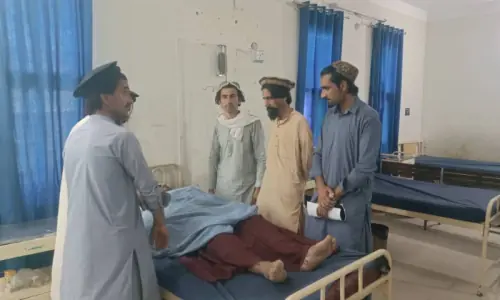
LAHORE: The children ward in the Ganga Ram Hospital is crowded with people; there is the small-time political worker making the most of the moment, the media men who have been banned from entering the premises especially with their cameras somehow have sneaked in anyway, there are the patients’ families and of course the hospital staff.
A delegation led by Iran’s consul general has come to pay a visit and the cameras cannot get enough of that. The staff has politely taken a step back.
On one bed lies a man unconscious, a checkered sheet covering his face. Only his heavily-plastered leg can be seen, white plaster powder on his toes. His family is not nearby.
On the next bed is constable Rana Naseer, who was part of the police delegation which had come to Charing Cross to try and reason with the protestors there. He props himself up on his left elbow to talk. “When something like a bomb blast happens you cannot think in terms of time because you don’t know what hit you. One minute I was standing; next minute I had fallen to the ground.”
A broken leg would not stop him, he says, from trying to help those around him.
“They were falling on the ground all around me, I began picking them up. Then someone saw my broken leg and told me to leave in the ambulance. I saw my friend head constable Asmatullah among those on the ground, brutally mutilated by the bomb.”
The last time a bomb blast took place, more than 70 people, many of them children, were killed. The suicide attack had been at Gulshan-i-Iqbal on Easter, the responsibility of which was taken by Jamaatul Ahrar, a splinter group of the Tehreek-i-Taliban Pakistan.
Much of the blast’s impact was absorbed by two of the DSNG vans parked there. But unlike usual bomb blast victims who are visibly dazed, Naseer and some of the others who are injured seem to be calm and collected. Fifty-five-year old Ashraf, who was one of the protestors, is even smiling.
“What else is there for us to do,” says the ageing man, as he lies back in bed, one leg plastered because of ball bearings and shrapnel. “We Pakistanis must retain their humour because perhaps it is the only asset that we have left to stay resilient in such times.”
Ashraf had been with the protestors the whole day and moved away to a pavement to rest his legs, which is when the incident took place.
“I was thrown back and felt the ground shake. When I saw people running I tried to get up but could not,” he said. “That was when I realised my leg was badly injured.”
Mohammad Abbas, who was also part of SSP Gondal’s delegation, said he had fainted for a few seconds and then had to drag himself away by moving forward on his elbows because his legs were badly injured. “I am in a state of shock knowing that the man who I used to work for and who was very much there yesterday - hale and hearty - is today no more.” He remembers him as a down to earth man who would respect everyone. “He would address his junior officers as ‘Sir’,” he says.
Abbas has suffered from ball bearing injuries in his legs but hopes he will heal soon. Three big white spots mark his hand where the heat from the bomb burnt his skin, and even his hair has been singed badly.
While those wounded are trying to keep their hopes up, Mohammad Hafeez, one of the protestors, is steaming about how he says the media has unfairly covered their side of the story. “From today we are without work, because of the draconian Drug Act,” he says. “And yet we are the ones being turned into demons.”
Hafeez was there at the incident but escaped any injury. Mentally he too seems unscathed and untraumatised.
“My cousin and I ran from the area when I saw the flames go up,” he says.
Outside the hospital resting on the pavement right next to the gate is a bevy of Falah-i-Insaniat Foundation (FIF) workers, donning fluorescent green jackets and taking a break from work. Ironically every time a terrorist attack takes place, the banned FIF is seen working alongside the government’s Rescue 1122 service.
SITE OF THE INCIDENT: A grim, black tent cordons off the exact location where the blast took place. The rest of the site is fenced in with barbed wire. No one is seen inside, but scattered police officers dot the surrounding area in their dark and beige uniforms.
In a macabre combination to the scene eagles swarm over the area where the dead bodies lay a night ago. Somewhere on the side of the road among the protestors’ cardboard lunchboxes strewn aside, a lone broken shoe lies, its other twin missing.
Published in Dawn, February 15th, 2017