0
0

KARACHI: Trade unions, civil society and labour rights activists on Friday urged the provincial legislature to initiate a debate on workers’ rights and suggested some amendments to the Sindh Tenancy Act, 1950 and other laws to protect the right of social security of all workers.
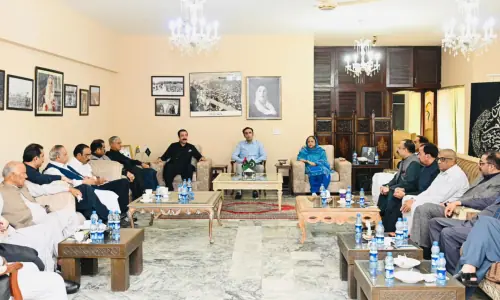
They expressed these views during a meeting with members of the provincial assembly, organised by Pakistan Institute of Labour Education and Research (Piler).
MPAs Nusrat Saher Abbasi, Naheed Begum, Mahesh Kumar Malani, Naila Munir, Sorath Thebo, Kulsoom Chandio and Sikandar Shoro, belonging to both treasury and opposition benches, were briefed at the meeting about non-implementation of the existing labour laws in Sindh.
They were informed that in 2009, the peasants’ rights activists had organised a ‘long march’ from Hyderabad to Karachi. They presented a draft of amendments to the Sindh Tenancy Act, 1950 to Deputy Speaker Shehla Raza at the Sindh Assembly building.
A parliamentary committee, which was later formed, discussed the Sindh Tenancy Act during the last tenure (2008-13) of the government and recommended some amendments, but they were not presented before the house. In March 2013, the Sindh Assembly passed minor amendments to the act that turned out to be counterproductive for workers, the lawmakers were told.
The lawmakers attending the meeting assured the civil society representatives that they would raise the issues of workers in the house. They asked the rights activists to provide specific information to them about lacunae in the existing labour laws.
Karamat Ali, executive director of Piler, said that majority of labourers were deprived of right to association and right to collective bargaining, which had been ensured under the Constitution and ILO conventions.
He asked the lawmakers to make a separate law for the registration of trade unions on the pattern of India Trade Union Act, 1926 for which Quaid-i-Azam Mohammad Ali Jinnah had played a key role in the Indian legislative assembly. The law had been adopted by Pakistan after independence, but military dictator Gen Ayub Khan scrapped it. Since then it has not be restored, according to Piler.
He also mentioned lacunae in the recently passed Sindh Prohibition of Employment of Children Bill, 2017 in which minimum age for working of a child had been fixed at 14, which, he claimed, contradicted Article 25-A of the Constitution, which ensured the state would provide compulsory education to every child up to age 16. Under the Child Rights Convention (CRC) the age was fixed at 18 years for work, he added.
Habibuddin Junaidi, Sadiqa Salahuddin, Zulfiqar Shah, Raheema Panhwar, Naghma Shaikh, and Zeenia Shaukat from Sindh Human Rights Commission also spoke.
Published in Dawn, February 11th, 2017