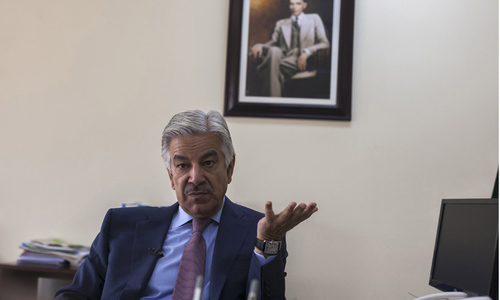
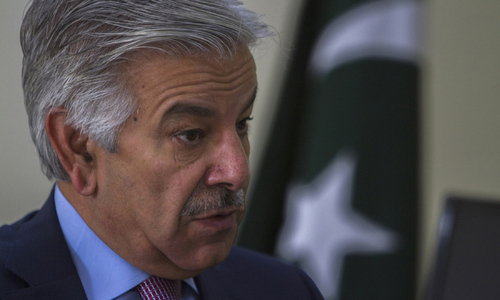
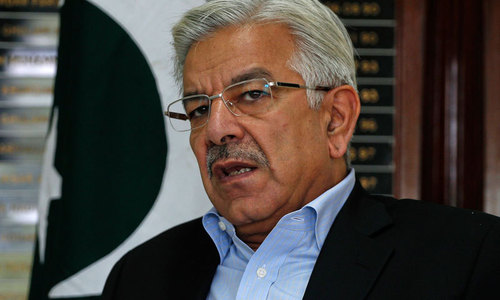
Minister for Defence, Water and Power Khawaja Asif on Tuesday said Pakistan would not accept any external pressure on the Indus Waters Treaty (IWT) reached with India in 1960 for distribution of water between the two countries.
“Each and every clause of the IWT should be followed by both the signatories in its letter and spirit,” he said while speaking to journalists after addressing a national seminar.
The seminar titled “Hydro Politics around Pakistan: Reassessing the Efficacy of IWT”, was organised by the Institute of Strategic Studies, Research and Analysis (ISSRA) in Islamabad at the National Defence University (NDU).
Commenting on India's latest move to build the Ratle Dam on the River Chenab after the Baglihar and Kishanganga project, the minister said Pakistan did an extensive exercise regarding the issue over a period of a year and a half.
“Pakistan's case is stronger than that of India and we will safeguard its national interests at every cost,” he asserted.
Answering a question, the minister underlined the need to conserve water, electricity and gas, and highlighted the importance of developing a habit of conservation at every level.
Under the existing system, he said, Pakistan had sufficient water resources to meet its needs but “we will have to end the culture of wastage.”
Replying to another question, Asif said around 6,500 megawatts of electricity would be added to the national grid during a period from April to December this year.
The electricity will be coming from five power generation plants of which two are coal-fired and three are LNG-based.
“This will help eliminate the power shortages in peak summer season,” he said, adding that an additional 3,500 MW of power would be added to the system from other resources by the end of the current year.
He expressed confidence that Prime Minister Nawaz Sharif's commitment with respect to overcoming loadshedding by 2018 would be fulfilled.
Addressing participants of the seminar earlier, Asif had said that the waters regime as envisaged in the IWT continued to bear the brunt of the Indian mindset and India's alleged inclination to interfere with water reserved exclusively for Pakistan.
“The potential to interfere is widened if not actualised, in the backdrop of conflicts between the two countries,” he said.
However, he added, the treaty was an instrument which could help avoid wars, so Pakistan's focus remains on implementation of the treaty in letter and spirit.
“The question of upper and lower riparian is essentially a misnomer in the IWT context. In the first place, Pakistan needs to stick to the treaty, while placing emphasis on its true implementation.
“We need to keep in mind that the country's water security dilemma is accentuated in the absence of an effective water storage capacity, water conservation and management strategy,” Asif remarked.
The minister said the situation could be improved through a multi-pronged strategy, efficient time management, and strong political will to translate plans into reality.
“We should put our house in order and take meaningful steps to enhance our storage capacity.”
He said both the countries were bound to follow the IWT clauses in letter and spirit and no side could abrogate them unilaterally.
In his welcome address, President NDU Lt Gen Rizwan Akhtar said the IWT had been a most outstanding achievement which established a technical formula and mechanism for water division of the Indus River Basin system in an otherwise politically volatile region.
The legal instrument, he said, had so far sustained and delivered despite ups and downs in Pakistan India relations.
Other participants of the seminar emphasised that water, being a lifeline had become an important factor in shaping the relationship between co-riparians in the changing geo-strategic environment.
Highlighting Pakistan's primary concerns regarding the IWT, the seminar participants gave different suggestions to counter the Indian hydro hegemony in an effective manner.