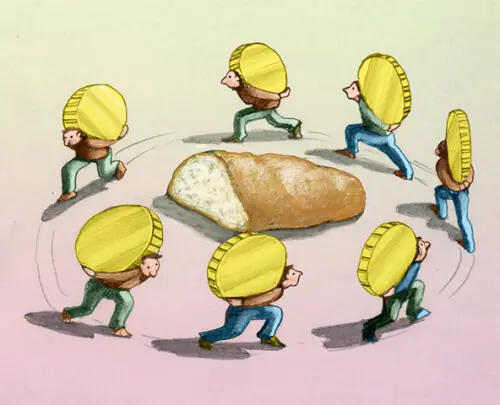
The concept of modern state in the 21st century is based on the social and economic welfare of the people.
The state, under the cover of social contract, as enshrined in the constitution, has obtained the power of taxation with a promise to spend the collected money on public welfare.
The annual budget of different governments contains subsidies and welfare grants for the marginalised or poor segments of the society. These subsidies and grants are disbursed from the taxes collected.
To enhance economic welfare, different methodologies for the distribution of subsidies or grants to the people have been adopted by the various governments around the world. These methodologies include provision of utilities at lower prices, food vouchers, privilege cards etc.
A negative income tax works on the principles of progressive taxation where a person whose income falls below a certain level receives financial support from the government instead of paying tax
However, another method called the negative income tax approach has been suggested by a British politician Juliet Rhys-Williams and later developed by renowned economist Milton Friedman. A negative income tax works on the principles of progressive taxation where a person whose income falls below a certain level receives financial support from the government instead of paying any tax. In this way, a minimum income level is ensured for every person in a country.
The debate on a minimum income based on the concept of negative income tax is presently being discussed under the title of Universal Basic Income (UBI) in different countries. There have been several experiments in implementing a UBI scheme based on different methods.

A UBI scheme based on the negative income tax idea promises a minimum basic income for every citizen in a country. A key feature in a negative income tax approach is the replacement of all existing subsides and grants programmes with a direct cash transfer system.
In Pakistan, the idea to introduce a negative income tax based on a flat rate can be understood from a simple illustration. Suppose a minimum taxable income slab of Rs400,000 for all citizens with a flat tax rate of 10pc exceeding Rs400,000 and a subsidy rate of 10pc, the following example illustrates:
There are several challenges in implementation for such a negative income tax scheme including correct reporting of a person’s income, efficient refund/distribution system, adjustment for local conditions, scrapping any existing subsidies system etc. These challenges can be addressed by learning from the experiments of levying negative income tax in US, Canada, Netherland and Brazil.
The existing experiment of Benazir Income Support Programme (BISP) in Pakistan is a step in the right direction for disbursement of cash aid to the deserving segments of the population. However, this programme needs to be expanded to include more persons in its list of beneficiaries.
The National Economic Registry (NER) should also be expanded to include more persons based on the minimum tax exemption slab and newly-designed multipurpose poverty line.
A benefit distribution approach based on the idea of negative income tax will save funds, reduce administrative work, lower corruption in subsidy schemes, empower lower segments of society and promote economic equality.
— The author is an assistant professor at AIOU, Islamabad.
Published in Dawn, Business & Finance weekly, January 16th, 2017