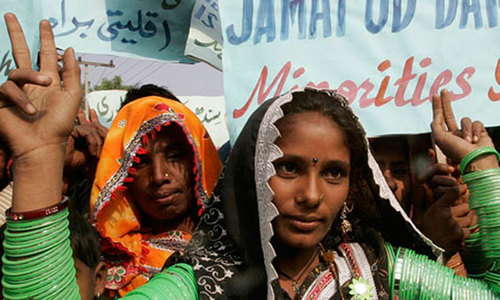
KARACHI: “Withdrawal of protection of minorities bill, unanimously passed by elected members of the provincial assembly, due to mounting pressure of unelected people will create a worrying precedent,” said Senator Farhatullah Babar on Thursday.
He was speaking at a conference on ‘Challenges to civic freedoms in Pakistan’ organised by Pakistan Institute of Labour Education and Research (Piler) where a number of prominent speakers presented their arguments for the recently passed bill by the provincial assembly.
Some parts of the recent legislation did not go down well with the clerics, which the speakers pointed out and discussed at length.
Senator Babar said: “Withdrawing a bill before the governor has put his signature on it won’t be a proper step.”
He said the legislators should have waited till the governor had signed the bill and then they could have carried out the required and necessary amendments.
“Plus, the reservation of the religious bloc against the bill that declared marriage of anyone under the age of 18 as unconstitutional is not reasonable. Removal of this clause will undermine the law,” he added.
In a clear reference to the military courts, the senator spoke against what he called the tradition of “tweeting information about hangings of suspected terrorists” and said that “legislation is, at present, hostage to ideological and national security argument.”
Sindh Human Rights Commission of Pakistan chairperson retired Justice Majida Rizvi said: “If the age factor is taken out of the bill, it will mean depriving the law of its teeth.”
She said it was the duty of civil society and the stakeholders to raise their voice whenever the authorities failed to implement the law.
“I don’t know why the government is paying heed to the clerics. It’s probably because of the elections but these sections don’t [form] a large vote bank,” she argued.
Journalist Mazhar Abbas stressed the need for having stronger defamation laws in the country and said “the recent spate of accusations made against prominent and less prominent people that they were working for the Indian spy agency, Research and Analysis Wing (RAW), and then those people not receiving any compensation for false claims made in the case, shows how weak the defamation laws are in the country.”
He also blamed journalists for using the exact terminology used in the press releases sent by the law-enforcement agencies. “We don’t know whether a person is rightly or wrongly accused. So, it would be better to use terms such as suspect and alleged. This will save a journalist’s credibility as well as a person’s life,” he added.
Published in Dawn, December 30th, 2016