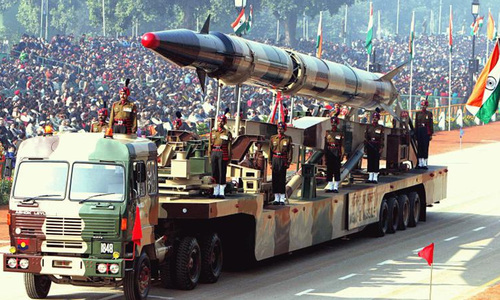
In a veiled reference to India, Pakistan voiced concern over the growing transfer of conventional armaments in volatile regions, saying it has every potential of fuelling instability and jeopardising the delicate regional balance.
“South Asia is a sensitive region where one state's military spending grossly and vastly outshadows all others,” Ambassador Tehmina Janjua, the permanent representative of Pakistan to the United Nations in Geneva, told the United Nations General Assembly's Disarmament and International Security Committee on Thursday.
“We remain concerned over the growing transfers of conventional armaments especially in volatile regions that are inconsistent with the imperatives of maintaining peace, security and stability,” she said in a thematic debate on conventional weapons.
“The policy of dual standards towards South Asia, based on narrow strategic, political and commercial considerations, must be eschewed,” the Pakistani envoy said.
Pakistan, she said, was committed to the establishment of strategic stability in South Asia, which includes an element of conventional force balance. “It [Pakistan] neither wants, nor is it engaged in an arms race in the region.”
In her remarks, Ambassador Janjua said efforts to eliminate nuclear weapons must not give way to an unworkable imbalance of conventional weapons similar to those that had triggered two world wars.
Spending on conventional arms had surpassed $1.7 trillion, she said, adding that the total budget of the United Nations was around 3 per cent of world military expenditures and that 33 times more money was being spent on fuelling and exacerbating conflicts than on preventing them.
Results would be few and far between if the issue of conventional weapons was not addressed in a comprehensive manner, the envoy said.
“The utility of a partial approach that separates motivations for arms production from the controls of their trade and transfers will be limited at best. As a result, these weapons will continue to fuel conflicts, destabilise states and societies, inflicting enormous pain and suffering to humanity,” she added.
Pakistan, she said, has developed the necessary legislative, regulatory, enforcement and institutional mechanisms to address the range of issues relating to conventional arms including small arms and light weapons.
“We are taking additional measures to strengthen the enforcement regime, which covers imports and licensing,” the envoy added.
Pakistan consider the the Arms Trade Treaty (ATT) as a first step towards regulating trade and transfer of conventional weapons and note its entry into force, she said.
“Even as we continue our national review of the treaty, we believe that ATT's success, effectiveness and universality will be assessed on its non-discriminatory implementation in particular its criteria and strict adherence by its State Parties to the treaty principles,” she said.
The success of Convention on Certain Conventional Weapons (CCW), she said, lies in the delicate balance it seeks to maintain by minimising human suffering without sacrificing the legitimate security interests of states.
Ambassador Janjua said Pakistan shares the concerns about the acquisition and use by non-state actors and terrorists of small arms and Improvised Explosive Devices (IEDs).