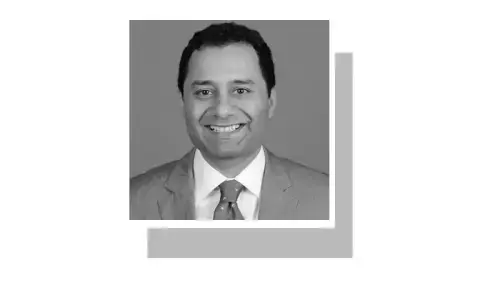
One of only a handful of Frenchmen ever to take responsibility for $1tn of other people’s money, Pascal Blanqué offers a sort of downbeat optimism about the world economy. Expansion, yes, just less than we are used to.
“Global growth is in the region of 3pc, fine. But the structure of global growth has changed, meaning that the contribution of manufacturing and global trade is down,” says the chief investment officer for Amundi, a combination of Crédit Agricole’s and Société Générale’s fund businesses which became Europe’s largest asset manager when it listed in Paris last year.
So investors conditioned to expect globalisation need to brush up on history, when growth was more modest. “We are back to a long-term framework, think before the inflationary years of the seventies,” says the economist.
Yet some of his conclusions about this tepid world might be considered radical: the very lack of growth means stock market valuations are justified; investors should return to emerging markets; US bond yields may not rise even if the Federal Reserve wants them to.
“Many investors behave as if they didn’t believe that interest rates would stay low for the foreseeable future. Or to say differently, they behave as if they were believing that rapid normalisation is around the corner,” says Mr Blanqué, who disagrees.
‘Traditional asset allocations are less prudent than ‘risky’ picks’
“Interest rates will remain extremely low. In that case, if you look at most strategic asset allocations today, across the globe and in Europe specifically, they are sub-optimal,” he says.
Portfolios found in pension funds and asset managers are constructed by holding a combination of safe government bonds and risky stocks. “It was a comfortable framework [and] actually, it’s gone. It’s gone”, says Mr Blanqué. “Those asset allocations are seen as prudent, but they are less prudent than an allocation that would include more so-called risky assets.”
He advocates returning to emerging markets, one of the greatest sources of disappointment in recent years. “People have been trapped in the marketing bubble, with simplistic stories about the emerging markets’ growth potential, currencies that can only go up,” he says.
He says investors should consider internal dynamics, such as diversification of the economy in Malaysia, or rebalancing in China. “My problem is not to get an exposure to an exporter, necessarily, but to get an exposure to services. Or infrastructure in Thailand, these kinds of things,” he says.
In developed markets, low growth and low interest rates mean scarce profits are valuable. “What is seen as extremely expensive today, it’s probably less expensive than we think,” says Mr Blanqué, with one caveat, that an extensive bout of deflation is avoided.
Instead, it is the policies employed by central banks to avoid the damage of deflation that matter, and continue to be underestimated eight years after the crisis forced authorities to adopt extraordinary stimulus measures.
Every large asset manager must persuade clients of some insight to the way ahead, particularly when cheap passive investment products continue to attract money from those charging higher fees.
With a collective failure by hedge funds over the past decade to generate ‘alpha’, Mr Blanqué suggests an alternative more suited to a world of passive investment in stock and bond indices.
Pension funds and others will be persuaded to seek exposure to forces such as momentum or liquidity, rather than individual skill. “I’ll take a bet that in three years’ time we will be defining alpha as what is coming on top of a systematic exposure to some factors. This is what the factor investing revolution is about,” says Mr Blanqué.
For now though, he says too many institutions still cling to familiar assumptions. For instance, he argues one of the biggest investment mistakes of the past three years was to prepare for higher bond yields, which would push down prices for securities where the interest rate is fixed at issue. “It creates a sort of feeling of comfort, we will go back to the old framework.”
Yet it was also because many bond managers were stuck in a Fed-centric view, he says. It used to be enough to read the minutes of the central bank to work out what would happen to the yield curve, the arrangement of short and long-term interest rates that determines the shape of bond markets.
In the past, when base rates started to rise in response to growth, long-term interest rates would rise faster, reflecting expectations about future inflation. The yield curve would steepen.
“Now you’ve got a change in the DNA of most big central banks, outside the US, which means that you’ve got liquidity from Japan, Europe, etc,” he says. Suppression of interest rates around the world, and the ease of investing in different currencies, means US bond yields are attractive and any rise “will be taken as an opportunity by European-based or Japanese-based investors which means, basically, that the Fed will struggle trying to steepen the curve”.
Published in Dawn, Business & Finance weekly, August 15th, 2016