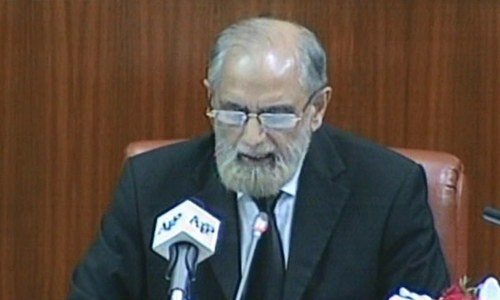
ISLAMABAD: Acknowledging the hardships and difficulties family members of the missing persons faced, the Supreme Court decided on Wednesday to divide a set of 97 cases into four blocks to be taken up by four benches once a month.
“The litigants come from different parts of the country and one can imagine the level of disappointment the family members undergo when their cases are not taken up,” Chief Justice Anwar Zaheer Jamali observed, explaining further that it was not possible to hear all the 97 cases in one day.
From now on, four benches consisting of three judges each will hear the matter divided equally between them rather than the present five-judge larger bench, which was hearing a number of cases being pleaded by rights activist Asma Jahangir. She was representing, among others, the Human Rights Commission of Pakistan and Amina Masood Janjua, chairperson of the Defence of Human Rights.
At the last hearing on April 7, the chief justice had regretted that such an important case had been brought before the court after two years.
On Wednesday the court explained that it was not trying to sideline the missing persons cases, rather facilitating the litigants because the court has sympathy with the well-wishers and relatives of the people gone missing.
FEAR & HARASSMENT: Ms Jahangir regretted that retired Justice Javed Iqbal’s Commission of Inquiry on Enforced Disappearances (CIED) is not accessible to every affected family as people are afraid to speak their heart out because officials of the Military Intelligence, Intelligence Bureau and the Inter Services Intelligence are also present there and try to intimidate them with aggressive postures.
Citing an example, she recalled that an official of a security agency accused of picking up a person attended a hearing of the commission recently.
Previously the commission used to hold hearings inside the interior ministry, but now it sits in the Civil Defence department building, where relatives of the missing persons face harassment from intelligence sleuths.
Ms Jahangir also suggested to the court to ask magistrates to record statements of persons who have been released by the authorities and take action against officials found to be misusing the forum.
While referring to a list of 36 missing persons compiled by the HRCP, Deputy Attorney General Sajid Ilyas Bhatti told the court that the whereabouts of four persons had been found. They are Nasir Khan (detained in the internment centre at Kohat), Amara Khan (Pathom, Swat), Mohammd bin Abdul Shakoor (Lakki Marwat) and Mohammad Tayyub (Malakand). The others are not in the custody of federal agencies, he added.
The DAG said out of 3,368 cases referred to the commission till May 31 this year, 2,017 had been disposed of.
Last month, he added, the commission heard 217 cases in Islamabad and 165 in Karachi.
On an application filed by Abida Malik, the court ordered the Additional Advocate General (AAG) of Khyber Pakhtunkhawa, Mian Arshad Jan, to arrange a meeting between her husband Tasif Ali, who is under detention in Kohat, and his family within two weeks and submit a compliance report.
According to Abida Malik, the last time she met her husband was three years ago on a directive of the court. The court also sought reports from the AAG about two missing persons — Saeed Ahmed and Fasihullah.
Amina Masood told the court that the authorities had handed over the body of a missing man, Gul Faqir, to his heirs while two persons, Ghulam Amjad and Sajjadul Hassan, had been released.
She informed the court that 56 cases had been lingering for a decade.
Advocate Tariq Asad argued that although the commission is headed by a former judge of the Supreme Court, it lacks judicial powers. As such, he added, the apex court should try to help recover missing persons.
Published in Dawn, June 16th, 2016