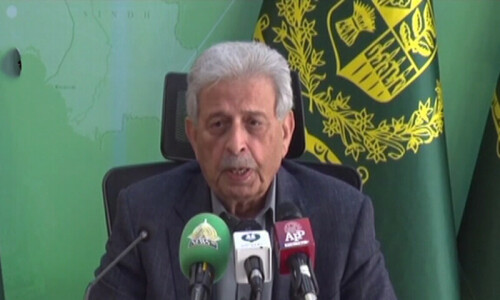
ISLAMABAD: The country’s seven flood warning radars are now obsolete, this was disclosed at a meeting presided over by the federal minister for planning and development, Ahsan Iqbal, on flood preparedness and monsoon rains forecast by the Pakistan Meteorological Department (PMD).
Those present at the meeting were also informed that the government was short on funds to mobilise the Rs7 billion Early Warning System (EWS) project.
According to an official who attended the meeting, the oldest flood warning system was installed in Sialkot in 1978 while the latest one was installed in 2004 in Mangla. He said that even though Khyber Pakhtunkhwa had seen repeated flash floods since 2010, the only warning system set up in the province was in Dera Ismail Khan in 1994.
He explained that the PMD had proposed a Rs7bn project for a modernised early warning system for the entire country with 21 radars but could not get immediate support.
The official said that as a part of the project they would install radars in Gwadar, Zhob, D.I. Khan, D.G. Khan and Quetta along with 40 observatories in the remaining districts at a cost of Rs3.7bn.
Automation of nearly 100 existing observatories would cost another Rs500 million while 200 Automatic Weather Stations (AWS) would cost Rs1bn, a Glacier Lake Outburst Flood (GLOF) station in Gilgit Baltistan and Upper KP worth Rs450m besides wind profilers, warning communication system and cell broadcast and FM weather radio.
The minister claimed that the cost of the project was quite high and could not be funded immediately. However, he added that the project should be processed for multi-year financing.
PMD Director General Dr Ghulam Rasul confirmed that “our radar network is very poor” as the life of a weather system radar was 10 years after which they became obsolete.
He said that a new radar system was being set up in Mardan (following losses in Chitral last year) which would be operational by 2017. He added that devastations of floods could not be avoided without overcoming technological gaps.
According to Dr Rasul, the government was keen on modernising the EWS given the increasing frequency of weather-related disasters.
He said this would help go beyond the mountainous region and into the glacial region where GLOFs had become very common due to accelerated melting of glaciers and monsoon rains.
Dr Rasul added that lessons learnt last year from the devastation in Chitral had helped them improve the EWS. The World Meteorological Organisation (WMO) which supervised 198 Met services in the world have held studies and research that a dollar spent on the EWS saved $36 in return because the EWS was the first line of defence against floods and devastations.
He said the chief minister of Punjab had promised to provide support to three radar systems in his province — Sialkot, Lahore and Mangla — with modern technology. This project, he added, would cost Rs4bn and could be completed in two years.
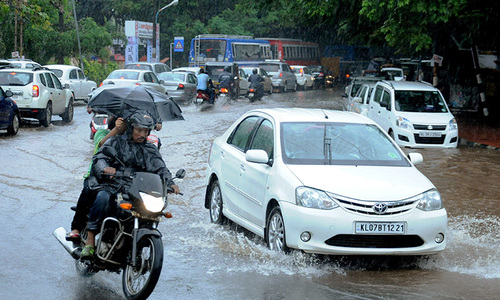
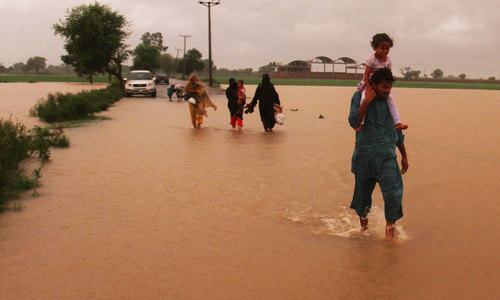
According to the federal minister, departments concerned should take pre-emptive measures to deal with the flooding situation in view of monsoon rains this year which will be 20 per cent higher than normal rains.
“They should be prepared to minimise losses caused by the expected high-floods in the country in the coming monsoon season,” he said, adding that relief activities and provision of medical facilities should be planned in advance.
He said the country was suffering from abnormal conditions due to climate change and needed a sound preparedness at the national level to minimise losses. He added that the early warning system was the first line of defence against floods.
He asked the civil defence authorities to ask the youths to help and volunteer in flood related relief activities.
Published in Dawn, June 16th, 2016