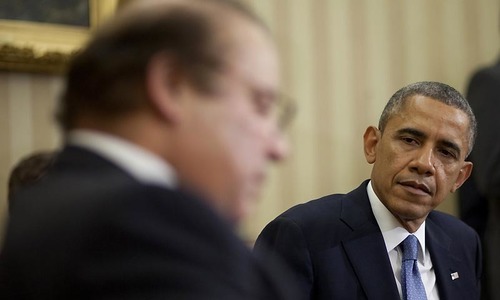
A COMPLICATED, but vital relationship — an assessment offered by the US State Department spokesperson — is an apt description of the state of Pak-US relations.
But the latest stresses in the bilateral relationship have not come as a surprise. For a couple of years now, as the US military engagement in Afghanistan has diminished markedly, the possibility of a changed relationship between Pakistan and the US has been clear.
And yet, while efforts such as the strategic dialogue have continued, there have been signs of mutual fatigue — the stresses and demands of a post-9/11 security-based relationship appear to have taken their toll in the form of a lack of any direction of overarching vision on both sides today.
Where once there were initiatives such as the Kerry-Lugar civilian-focused aid and attempts to spur regional trade and productivity, now there is little more than haggling over bills and military hardware.
Inside Pakistan, the civil-military dynamic has clearly affected the trajectory of the Pak-US relationship and pushed it in the direction of being wholly security-based.
But part of the blame must surely lie with the civilians and the present PML-N government in particular.
So invested is the government in the Chinese relationship and the possibilities that CPEC offers that it appears to have become oblivious to all other foreign relationships, barring perhaps the occasional ill-planned attempt to begin a process of normalisation with India.
Consider that when Prime Minister Nawaz Sharif went on an official visit to the US last year, the highlight of the trip was an announcement of a small-scale effort to boost female literacy in Pakistan.
Trade was nowhere on the agenda and little effort was made to engage the US Congress, thereby contributing to a drift that has allowed elements hostile to Pakistan in Congress to shape the emerging narrative on Pakistan.
Even now, with the F-16 issue cropping up, there has been no attempt by the government to conduct emergency diplomacy.
Distracted by the Panama Papers controversy and seemingly having ceded control over policy on the US to the military, the government – still without a foreign minister – has been reduced to articulating sad-sounding admissions of struggles in the bilateral relationship.
The country needs a full-time foreign minister, it needs a government that recognises the importance of maintaining ties with the US, and it needs a political leadership that can engage the military on national security and foreign policy matters.
Unhappily, none of that appears to be likely anytime soon. The F-16 debacle is only a sign of things to come if some urgent thinking is not done here on the relationship with the US.
Published in Dawn, May 16th, 2016