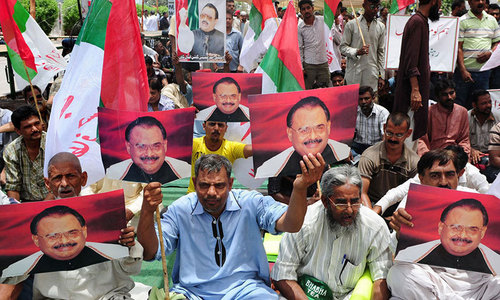
KARACHI: The Chief of Army Staff (COAS) Gen Raheel Sharif on Wednesday ordered an inquiry into the death of Mutahidda Qaumi Movement (MQM) activist Aftab Ahmed, who died in the custody of Rangers paramilitary force under controversial circumstances.
While directing to hold an inquiry into Ahmed's death, the army chief instructed "justice must be done", the Inter-Services Public Relations (ISPR) said in a statement.

Meanwhile, the Rangers said in a press release they suspended an unspecified number of officials for their 'suspected involvement' in Ahmed's death. Director General (DG) Rangers Maj Gen Bilal Akber set up an investigation team to probe the cause of Ahmed's death and "reveal the facts", it said.
Maj Gen Akber on Tuesday accepted that the deceased MQM worker was tortured by Rangers in custody, but maintained that he died due to a heart attack.
The development comes after pictures and videos doing rounds on the social media showed the corpse of the deceased MQM worker having severe torture marks across his body.
Aftab Ahmed was said to a coordinator of senior MQM leader Farooq Sattar.
Heart attack or torture?
While doctors reserved the cause of death of Ahmed, the paramilitary force claimed that the activist died of heart failure, Dawn newspaper reported.
The MQM, however, rejected the Rangers’ claim and blamed the force for brutally torturing the activist in custody and then influencing the post-mortem examination. It demanded an independent inquiry commission to determine the real cause of Ahmed’s death.
Rangers officials claimed that on early Tuesday morning Ahmed complained of “discomfort in breathing and chest congestion” and was rushed to the Jinnah Postgraduate Medical Centre, where he died after 25 minutes of admission and treatment at the emergency unit of the health facility.
Read: Rangers’ powers extended for 77 days
A brief statement issued by the Rangers said that Ahmed was arrested by the paramilitary force on May 1 “due to his involvement in several crimes” and an antiterrorism court was informed about his 90-day preventive detention for investigation.
“Early morning today [Tuesday] he complained of pain in the chest and he was immediately moved to hospital, where he died of cardiac failure,” it said, without mentioning as to how the Rangers determined the cause of death.
Cause of death reserved
The account of Dr Seemin Jamali, the head of the JPMC’s emergency unit, did not support the Rangers’ version, as she told Dawn that Ahmed had “no pulse and no blood pressure” when he was brought to the hospital.
“The doctors and staff did their best and cardiopulmonary resuscitation was performed on the man but it failed to revive him,” she said about the treatment process.
The MQM activist’s autopsy was conducted by a team of doctors under the supervision of a judicial magistrate (south).
The information shared by doctors also raised questions about the cause of death as claimed by the Rangers.
“He was brought here at around 7:55am and he died during treatment at the emergency unit at around 8:20am,” Additional Police Surgeon Dr Kaleem Sheikh, who was part of the team which conducted the post-mortem examination, told reporters.
Dr Shaikh remained silent when asked whether the body bore marks of torture.
About the exact cause of death, he said: “The report has been reserved. We have sent samples for chemical examinations. We can only tell you about the cause of death once the process is complete. Before that we cannot comment on that subject.”
Ahmed, 42, was a resident of Federal B Area’s Block 14 and father of five.
He had been associated with the MQM since 1990 when he joined Unit-85 of the party’s organisational structure in Landhi.
He had been serving as the coordinator to Dr Farooq Sattar since 2002.