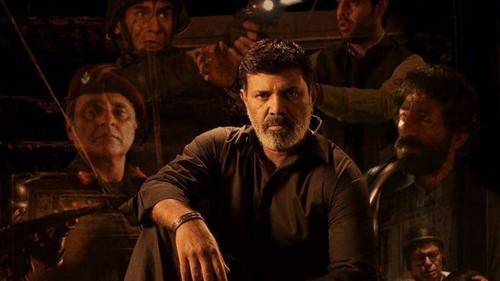
FOR most observers outside Pakistan, it would appear an inexplicable set of events.
On Tuesday, the Sindh government considered imposing a ban on the film Maalik — which had since April 8 been being screened across the country — on the basis that it showed certain communities in Karachi in a ‘derogatory manner’ (read: ethnic stereotyping) which could lead to unrest, and that it portrayed the (fictitious) Sindh chief minister as corrupt.
Before the notification was formally issued, however, Sindh Chief Minister Qaim Ali Shah intervened, saying that the matter should be taken up with the federal film censor board.
A day later, the federal government pulled the plug on the film across the country, first saying that it was ‘uncertified’, and later raising objections that it contained problematic portrayals of, for example, the police force.
However, given that the film had been issued a certificate for public viewing before it was screened, to those who know Pakistan and its history of civilian-military imbalance, a much simpler explanation is available: the film, with its portrayal of a tainted civilian governance system and its promotion of the armed forces, touched a raw nerve.
Perhaps already spooked by the stereotyping it is subjected to generally and in current times by the allegations flying around after the Panama leaks, the political leadership lashed out against a readily available target.
The state of Pakistan’s ready willingness to resort to bans results more often than not in exposing the mindset of those in positions of leadership.
There is no doubt that space is rapidly shrinking in the country for the multiplicity of views. Further, are those in positions of authority, civilian or military, resorting to petty point-scoring?
This implication can be read into another incident that occurred on Wednesday: Indian filmmaker Kabir Khan, whose film Phantom was considered critical of Pakistan and banned here, and who had been granted a visa by the federal government, was surrounded by a group of ‘protesters’ as he arrived at the airport in Karachi.
How they knew the identity of one passenger out of hundreds, though, especially one who works behind the camera, remains a mystery.
The tussle between various powerbrokers in Pakistan may be old news, but it appears now to have reached the level where dominance of the narrative is being contested.
Sadly, this augurs ill for the freedom of expression and the plurality of viewpoints in the country.
Published in Dawn, April 29th, 2016