KARACHI: Centralised policies of the state destroyed the idea of identity in Pakistan and as a result of its, religious extremism took root in the society which the state decided to address recently through military might in North and South Waziristan.
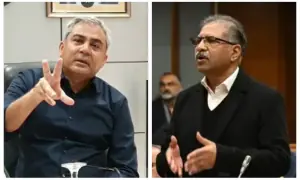
This was said by director of the Pakistan Study Centre at the University of Karachi Dr Syed Jafar Ahmed during the second session of a two-day workshop titled ‘Religious harmony and political Islam’ on Wednesday.
Organised by an Islamabad based non-governmental organisation, the Pakistan Institute for Peace Studies (PIPS), the workshop specifically focused on religion and its relation to politics, education and identity.
Majority of the participants in the workshop were religious scholars from Sindh, Balochistan and Khyber Pakhtunkhwa.
Speaking about identity and a culture of intolerance in Pakistan, Dr Jafar said at present the idea of a good Pakistani meant to push away one’s identity as a Punjabi, Sindhi, Pashtun and Baloch.
He said that multiculturalism and multilingualism of the Pakistani society could have been used to better integrate different groups in the country, but it created different enclaves and pockets in major cities.
“A case in point is the city of Karachi which reflects every other community eking out a living in alienation. However, these groups will not always live in isolation because at one point they’d want political representation in the city for which they gave their blood and sweat and we’d have to tolerate and accept this demand as the state is incapable of fulfilling that responsibility.”
Dr Jafar touched upon various points during his twenty-minute speech, but the main focus of his argument remained the state and its ‘collusion’ in stoking a debate over religious identity in order to fulfil its strategic or internal purposes.
Explaining his point further, he said: “Mohammad Ali Jinnah invoked the religious identity of Muslims to create a separate state representing Muslims as well as others. But after the formation of Pakistan, the state used Islam to legitimise its authoritarian centralised regime. The state patronage and appeasement of such groups went to such an extent that during the rule of military dictator General Ziaul Haq, religious outfits started extending the state agenda.”
Speaking on more or less the same lines was former professor at the Quaid-i-Azam University, Islamabad, Dr Abdul Hameed Nayyar.
Since the global debate on religion, identity and cultural intolerance is largely shaped by constant violence by a group of militants trying to impose their ideology, Dr Nayyar first spoke about the imposition of shariah and whether it was workable.
He argued that imposing shariah could not work in the present times as it would exacerbate sectarian and religious conflict in an already conflict-ridden and divided society. “Shariah speaks about the power of one group and one thought over everyone else. It is not acceptable since every group and sect has a different understanding of shariah,” he added.
Dr Nayyar added that harbouring the idea of shariah in a society which also included people from other faiths, no matter how small, was a way to invite religious disharmony and conflict.
Bringing up the point about curriculum during his speech, Dr Nayyar said: “We can’t expect religious harmony if we keep the same curriculum which is full of malice against people of other faiths. We should teach curriculum which is more inclusive and protects the right of the marginalised.”
Earlier in the day, a group of teachers and religious scholars from Sindh and Balochistan spoke about school and college curriculum and whether it was necessary for the non-Muslims to study Islamiat.
Majority of scholars, including students, were of the idea that ethics should be made mandatory for non-Muslims.
Published in Dawn, April 28th, 2016