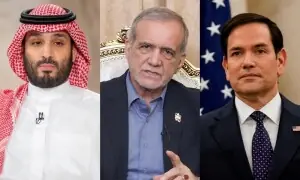
THE statement issued at the recently concluded Organisation of Islamic Cooperation summit in Istanbul is unprecedented for the harsh, undiplomatic tone used for a member state. Buried in between rhetoric about Palestine and Kashmir in the lengthy statement is a scathing attack on Iran, as the document deplores “Iran’s interference in the internal affairs of the states of the region. ...” as well as the Islamic Republic’s “continued support for terrorism”. Hezbollah, Tehran’s Lebanese ally, is also not spared “for conducting terrorist activities in Syria, Bahrain, Kuwait and Yemen”. For a moment, it appears as if these verbal assaults have come from a more traditional foe of Iran, such as Israel, instead of from within the OIC. This development, unfortunately, reflects the deep polarisation that is today threatening to tear the Muslim world apart.
There is little doubt that the acrimonious content of the statement is a reflection of the ongoing Saudi-Iranian feud. For long, the Saudis have dominated the OIC (the latter is headquartered in Jeddah), yet perhaps rarely has the organisation been used to lambaste a member state in this fashion. Iranian displeasure was indicated by the fact that President Rouhani did not attend the closing meeting. Indeed, the Iranian role in parts of the Middle East is questionable, with Tehran and Hezbollah providing critical support to Syrian strongman Bashar al-Assad’s regime. But where the Syrian imbroglio is concerned, no one’s hands are clean: along with the Iranians, the Saudis and other Gulf Arabs, Turkey and the West have all used the unfortunate country as a proxy battlefield, backing different militant groups. So calling out Iran on this count is a tad hypocritical. The fact is the Saudi-Iranian rivalry is playing out across the battlefields of the Middle East. Which is why it is particularly unfortunate that the platform of the OIC — meant to promote unity within the Muslim bloc — is being used to issue inflammatory statements.
The portents are not good. If this is the level of trust among the world’s major Muslim powers, then possibilities of further sectarian fragmentation are considerable. It would be interesting to hear what, if any, Pakistan’s input was on this strongly worded statement. In the recent past, Pakistan has tried to act as a bridge between Saudi Arabia and Iran. While it should continue to maintain cordial links with both sides, under no circumstances should Pakistan be drawn into the partisan politics of the Muslim world. As for the OIC, in its nearly five-decade existence the organisation has achieved hardly anything of substance in any field — political, economic, cultural — and has served as little more than a talk shop for the Muslim world’s princes, potentates and rulers. Sadly, by allowing itself to be used in intra-Muslim bilateral and geopolitical disputes, the OIC risks losing whatever relevance it retains.
Published in Dawn, April 17th, 2016